


Written by Katherine Jameson Digby with illustrative insertions and Afterwords by Toni Vonk
The Report from AATPA Ottawa at the SAW
In the spring of 2026, Zachary “Fae” Johnstone, Canada’s celebrated spokesman on all things women, announced that he was undertaking a Trans Canada Tour where audiences would be invited to “Ask a Trans Person Anything” (AATPA).

https://transcanadatour.ca/about/

Johnstone’s partner in this endeavor would be drag artist and Mont Royal University instructor in gender studies, Matthew “Victoria” [Karla Marx] Bucholtz.
The tour evolved between April and August 2026. The Ottawa stage came at the end of the summer, coinciding with Capital Pride week.
International Gender Dissent readers may not be familiar with Canada’s two progressive media darlings. Fortunately for those of us in attendance at AATPA, one of the participants asked Johnstone and Bucholtz to trace their personal journey into their trans identity. The answers gave this author valuable insight into the journey of self-exploration that, for both men, has bloomed into generous publicly funded livelihoods, just being their true authentic selves.

Johnstone was born in 1995 into a military family and identified as queer (Johnstone used the term “queer” during the event, however his website states that he came out as bisexual) from 2010 to 2016, from ages 15 to 21. He then declared a trans identity at the end of 2016, initially as “non-binary.”

For his part, Bucholtz reported that he had always been attracted to women. However, growing up, as he did in the 80s and 90s in the interior Canadian province of Alberta, he was reluctant to come out as heterosexual. He has opted therefore to identify as “queer” and “trans” and was married to a woman in 2021. Toward the end of our AATPA evening together, Bucholtz attributed his trans identity in part to going clothes shopping with girlfriends in his youth and wanting to be the one trying on the women’s clothes.

Bucholtz went to some lengths to convince the Ottawa audience that Calgary, his current place of residence, is a dangerous frontier town, hostile to the “gender diverse.” In this context, Bucholtz himself is exhibiting extraordinary bravery by openly practising his gender in public.
Not to be outdone, Johnstone chimed in that he’d even done his gender in Saskatoon!
Ask a Trans Person Anything was held at the SAW centre, part of the Ottawa Arts Court, situated between the University of Ottawa campus and the Byward Market. Its website describes it as “an artist-run centre for politically and socially engaged performance and media arts.”
The room at the SAW was set up for approximately 50 people, and there might have been close to 40 in attendance at the peak of the event. The crowd was over 50 percent male, and the average age was probably 50.
Oddly, there was no ticket collection or check-in process, unlike they had had at AATPA Vancouver. The front door and the adjacent bar remained open throughout the event, allowing for the possibility that some of these older men had wandered in out of curiosity, and had stayed to cheer on Johnstone and Bucholtz.
Trying to attend “Ask a Trans Person Anything” in Vancouver. They won’t let me in. Here’s the video. pic.twitter.com/pnEY5SS7Kj
— Amy Eileen Hamm (@preta_6) July 31, 2026
Completely absent from the event was the demographic commonly referred to as “trans youth” with their ubiquitous surgical masks, noise-cancelling headphones and keffiyehs.

Source: https://nowtoronto.com/news/ottawa-pride-trans-march-2026-queer-and-now/
The event was scheduled for 5:30. There were 27 people present at that time. At 5:45, Johnstone and Bucholtz took the stage, looking every inch the fruit of publicly funded “socially engaged performance and media arts,” with their flowing colourful hair and their youthful goth aesthetic.
To their credit, the two gents announced their intention to jump right into the questions. Johnstone even claimed in his introductory remarks that “we’ve also had folks who disagree with us, and ask us hard questions, and that has been actually a really interesting part of the tour experience.”

Johnstone and Bucholtz took 23 questions from the floor, in a session that lasted until 7:30. The present article will attempt to group questions together by topic, in order to capture some general themes of the session.
In general, the crowd was sympathetic and friendly. Johnstone and Bucholtz’s gentle jokes were met with a soft ripple of approving laughter, typical of an older crowd that wants to encourage the younger folk to continue in their public speaking endeavors.
The lead-off question was whether Johnstone and Bucholtz support any limits on male access to female change rooms, and if so, how they would propose to enforce those limits.
Bucholtz’s response was that “Ultimately, we haven’t had an issue with this. […] I think we need to judge people based on their actions, not their identity.”
This prompted the questioner to ask whether all men should be allowed into women’s change rooms provided that the men refrain from committing sexual assault.
Johnstone then intervened that this was a “go-to talking point”:
When we talk about gender-based violence we talk about violence against women, it is not happening in public change rooms or bathrooms or in those spaces, it is happening in our own homes.
When we take the conversation away from real action to address violence against women, and we point at the trans person over there, we’re doing a disservice to survivors of gender- and sexual-based violence.
There was a bit more back and forth between Johnstone, Bucholtz and the attendee, until the questioner was told to be quiet.

The two following questions concerned eligibility for sport. One attendee pointed out that the purported “ban on trans athletes” is in fact a restriction on males competing in the female category. Bucholtz asserted, with no examples, that “many trans men compete in male categories, and win, all the time.”
As the questioner pushed her point, Bucholtz grew impatient with her refusal to refer to men as “transwomen” and women as “transmen.” This questioner finally stated to Bucholtz, “You are a man who identifies as a woman.” Bucholtz’s riposte was “I understand that that’s how you feel, but we’re going to deal with facts instead of feelings.

The questioner also stated that her own daughter had identified as trans for seven years and had only recently emerged from this identity. She shared that it had been “hell” for her family. Many people in the audience scoffed and laughed at the emotional woman when she excused herself from the event.
The sports questions prompted another female audience member to ask about the importance of using specialized vocabulary when discussing trans rights:
One of the things I noted earlier was that there’s like a real lack of information, right? And part of that lack of information comes from really simplifying something really, really complex, into two binary systems. […]
Unless you take a gender studies or a biology course in university and are willing to kind of unlearn some of those teachings it can be very confusing for people. They don’t know what language to use. They don’t understand the complexity of it, they don’t believe in the complexity of it.
So, I’m wondering at what point we need to start saying “this needs to be taught differently.”
I’m wondering what initiatives already exist, what kind of public policy initiatives there are, and how those can be supported in order to better educate people right from the start that these things are far more complex than they have been taught.

And here is where the evening began to get interesting. Rather than clucking their tongues in agreement at the shortcomings of “two binary systems,” Bucholtz and Johnstone instead endeavored to explain that the creation of new vocabulary to deliberately confuse and alienate the public had been one of the public relations failings of the gender lobby.
Bucholtz answered:
[…V]arious concepts that were developed as part of third-wave feminism and post feminism through trans studies; these concepts have now escaped the bounds of academia and now have a social capital, and their negotiation in casual discussion is outside of where those terms were really created, and so it makes it very difficult and charged to talk about those terms.
Johnstone built on this idea that the specialized vocabulary is not an asset to the movement:
I often say, like, we need a movement where you don’t need a gender studies degree to qualify, because […] if we’re speaking to the public about, like, cis-heteronormativity and neo pronouns, we’ve already lost the conversation.
[…W]e haven’t always been perfect in this. How do we teach people about gender and sexual diversity in a way that is understandable, but that doesn’t, like, simplify it too much at the same time.
[…] I also think that, you know, […] our side sometimes contributes to calling everyone who disagrees with us, a fascist.
[…] We also need to be able to explain these things in a commonsense way, and that’s where we screwed up, because I think we got on our high horse and we imagined that we could lecture the world, and sometimes shame the world, into getting on board, and that built a resentment.
[…] We showed them our weaknesses, and we did not put in the work to rectify them.

Nonetheless, some audience members had evidently come with high hopes of seeing gender critical feminists properly vilified, as per Johnstone’s most famous tweet of 2021. After the first three questions of the evening proved challenging for Johnstone and Bucholtz, the lone black woman in attendance asked the following question, and for what it’s worth, she was also the lone person wearing a surgical mask:
How do you manage to stomach discussions like this, when these white women are very clearly using Nazi and racist language to apply to you, and all other trans women, but also affecting black women, black lesbians, black women, and how do, you know, that you have to, like, interact with them?
Johnstone and Bucholtz did not take up the invitation to confirm that some audience members were Nazis. Bucholtz replied:
We also get a lot of people who maybe have heard some things not so great about trans people but want to hear what the other side has to say.
We get a lot of those people, so boundaries are important.
Johnstone went further trying to explain that the whole point of the evening was supposed to be to allow for dialogue:
We’ve often done these [events] where we’re speaking more to our own movement and encouraging folks. So, when somebody screws up, when they mess up a pronoun, when they have questions and don’t get it, that is not a bigot, right?

Current analytic commentary: Irene BritUSA: https://youtu.be/N3bzOQbVJUI
A follow-on question was posed by an audience member who had been approached in the past by Johnstone’s event volunteers, and who had asked her for advice in how to be more aggressive toward the opposition at demonstrations. Johnstone denied looking for ways to intimidate the opposition:
I think a lot of our effort has been to try to model how to have conversations with people who disagree with us, and to try to encourage us to be a little more, like, careful when we label someone a bigot or a neo-Nazi.
Both gentlemen used the word “like” a lot, possibly in an attempt to sound youthful and relatable, and possibly because their whole movement is “like” a human rights movement.
This tendency accelerated with Johnstone’s nervousness about losing the audience’s sympathy, as was apparently the case in explaining his notorious “Protect Trans Kids” t-shirt with the knife on it.
Like, I literally wore a shirt that had, like, “Protect Trans Kids” on it, and it had a knife on it. Like, but it wasn’t, like, “I’m going to stab you,” knife. It was like, “I like to wear black.”

Another area in which Johnstone and Bucholtz aimed for a newfound moderation is in the pushing of transition affirmation onto one’s family or friends.
One such question came from an earnest young mum with a colourful hairdo, which prompted Bucholtz to address her as “Non-binary, I’m guessing?”
The recognition of her non-binary status elicited a delighted giggle from the lady, who eagerly confirmed that she was, indeed, non-binary! And astonishingly, the non-binary mum had a ten-year-old child who was transitioning!
She was seeking advice on this from the two hosts, who had, after all, announced in their publicity that they invited questions on “what healthcare services are available to trans youth.”
Do you have questions about medical care for trans youth?
— CUPW (@cupw) May 22, 2026
Are you worried about what's being taught at school?
Through "Ask a Trans Person Anything" events, we want to give Canadians a chance to ask their questions and hear our side of the story. Info: https://t.co/DNpoQFYSAy pic.twitter.com/VYKx2CHozD
But Bucholtz answered:
Play cool, right? It’s always weird if your parents start saying “slay.” [Audience laughter]
It’s kind of the same thing for gender diverse kids. If you make their transition your whole personality it’s weird, right? And I see that with some of my [?] parents. They rush to support.
[…] Let them know that you’re supportive and that there’s resources there, but let them come to you. And I think that is probably the hardest thing for any parent, because, you’re like, “I’m going to help. I’m going to be in there.”
The colourful-haired non-binary mother sounded a wee bit disappointed at this vague advice, and said, “Your entire job is to help and protect, actually.”
Bucholtz responded, “And I think, if you think of it more as offering a buffet of supports, let them pick the ones that the kids need, because it might not be the ones that you think.”
Johnstone weighed in in the same vein, “I think, yeah, like, the helicopter parent energy can be really hard to resist.”

The lads had similar advice to a question about how to support a friend’s transition.
Bucholtz:
The number one thing that I always tell people though, is, talk to your friends, [who are transitioning] because we can create amazing scenarios for allyship. But always take your direction from the person and ask them what they need.
Johnstone then added, “And I would say the same. I think there’s also, like, a lot of it is, I think, an individual’s fear is, is not in proportion to the reality.”
Note in both cases the two hosts do not encourage a rush to affirm, they do not mention suicide risk, or the need for medication, and there is a suggestion that the “ally” in some cases is the one eager for unnecessary interventions.
Minutes into his introduction of Ask a Trans Person Anything, Johnstone volunteered that “We’ve had a lot of parents, a lot of parents of trans kids and queer kids who are coming to ask questions.”
Mid-way through the evening, Bucholtz declared “There are so many people who do early childhood development; I do not. So, I would default to those experts, those people who spend time doing something I refuse to do, which is spend time around children.”
It would appear, however, that Bucholtz’s refusal to spend time around children is not absolute, because he also said:
Whenever I’ve been working with younger kids, you know, you’ll go around, you’ll do a pronoun circle or something. You’re like,
“Oh, what’s your name? What are your pronouns?”
And they’re like, “My name’s Brad.”
I’m like, “Cool. What are your pronouns?”
[Brad is] Like, “I don’t know.”
In Johnstone’s case, as part of his response to the above question about childhood gender transitions, he offered “I also don’t like kids.”
One audience member asked whether Bucholtz and Johnstone were aware of the joke that circulated in the Tavistock Pediatric Gender Service in the UK in the 2010s, that the clinic was medically transitioning so many gay teens that soon there would be no gay people left.
Johnstone responded that the Canadian public assumes that it is a lot easier to access pediatric gender medicine than it actually is:
You know, young folks have to go through psychiatric assessments. They have to go through social work visits. There is, like, this whole wraparound support that needs to be there, where there isn’t a prescribed outcome, where it’s based off of the need, based off of experience, and generally, when we’re talking about younger kids, there’s like, the window is a pause.
We have a, like, a medical system for a reason, that is intended to be that, like the safeguard, to make sure that we’re giving care, like, the appropriate care to every child.”

Elsewhere in the Q and A, Johnstone claimed,
One of the things that we’re trying to encourage our world to do is to not react to the narrative that is being pushed by our opposition.
So, the best example is, they said they were going to protect the rights of parents, and we said, “parents don’t have rights, they have responsibilities.” And we felt so righteous when we did that.
Johnstone’s answer to the Tavistock question prompted a follow-up question from the audience. A woman said that she was heartened to hear Johnstone speak up in support of psychiatric screening of children before medicalizing their gender condition. Building on the possibility that the trans rights movement has had assertions attributed to it that it does not deserve, she allowed the two men to correct the common narrative that the trans rights movement favours unfettered access to gender-related medication for all ages. She asked, if it turned out that pediatric gender clinics in Canada were in fact NOT doing psychiatric screening of patients, but rather promising immediate access to medical treatments, would Johnstone publicly condemn this practice?
Johnstone’s answer:
This is what we didn’t want, is a question that is intended as a “gotcha.”
[…] I am NOT a physician. I am NOT the Canadian Medical Association. I am NOT a hospital.
Umm, I think, that these are actually, decisions, writ large, like, I hate that they are politicized, ‘cause they weren’t actually, ten years ago. And yes, we still of course need to figure out, because health care is always evolving.
However, I do not think I am qualified to determine what kind of assessments, what scale of assessment, what ways of providing care are the best for a whole population. I think it would be irresponsible for me to weigh in on if this practice, or that practice, is the best practice.
I’ll speak to my stance, which is indeed in relation to, you know, gender affirming health care in young folks, that, with support, with medical supervision, which it always is, they get prescribed it.
I trust it, because I trust doctors.
I reject the idea that there is some sort of conspiracy or agenda there, because I guarantee you, that trans people are not funded by big pharma [one laugh] although sometimes I wish we were [no laughs] because, Lord Jesus, it would help!
But that’s not the reality that we live in.
What’s again interesting about this rather flustered response, is that there is a recognition that perhaps there is not one single pathway for the whole gender-identifying population. There is an appeal to medical expertise, and there is no reference to suicide.

Source: https://www.city-journal.org/article/aclu-attorney-confesses-transgender-suicide-claim-is-a-myth
It will be interesting if Johnstone maintains his “trust in doctors” when Canada inevitably follows the rest of the developed world in ceasing medical interventions on pediatric gender patients.

Throughout the evening, Johnstone was anxious to downplay many of the central assertions that won the trans rights movement all their quick and early victories, and which are all turning out to be long-term public relations liabilities.
The catechism of the 2010s, that women who want single-sex spaces are Nazis, that parents who deny their child’s transition should lose custody, and that lack of observance of pronouns should be met with violence, were frenetically pulled back as Johnstone endeavored to explain to the crowd that these positions were weakening public support for the TQ+ movement.
Bucholtz, for his part, emitted the air of a bored cat, mustering his best Jeff Spicoli drawl to impart the message that the whole session was a bit beneath him. He made several jabs at Johnstone’s loquaciousness and even resorted to checking messages on his phone while Johnstone was talking.
The Capital Pride Parade was to happen in just a couple of days. Before the AATPA evening was over, one curious audience member asked whether Johnstone intended to help sabotage the parade, as he did last year in collaboration with Queers for Palestine.
Johnstone gave an answer that positioned himself as a potential mediator for any disruption in 2026:
I will reassure everyone that there is not going to be any stoppage at the Fierté Capital Pride Parade this year.
And if there is, I will go have some fun conversations with EVERYBODY involved, on every side of that conversation.
It’s not going to happen, and I do not comment on hypotheticals.
What kind of insights could an attendee glean from an evening spent Asking a Trans Person Anything?
The two men have in common that they are able-bodied white males with graduate degrees in the humanities, likely reared to expect white collar employment in adulthood. They both would have come onto the job market at a time when employers were actively seeking “diversity” in applicants. How much of their personal gender identity was developed in an attempt to qualify as “diverse” in the eyes of employers and funders?

If we take Bucholtz at his own word, he got into the gender world because of the clothes. He may be an authentic auto-gynephile in addition to being a successful grifter.
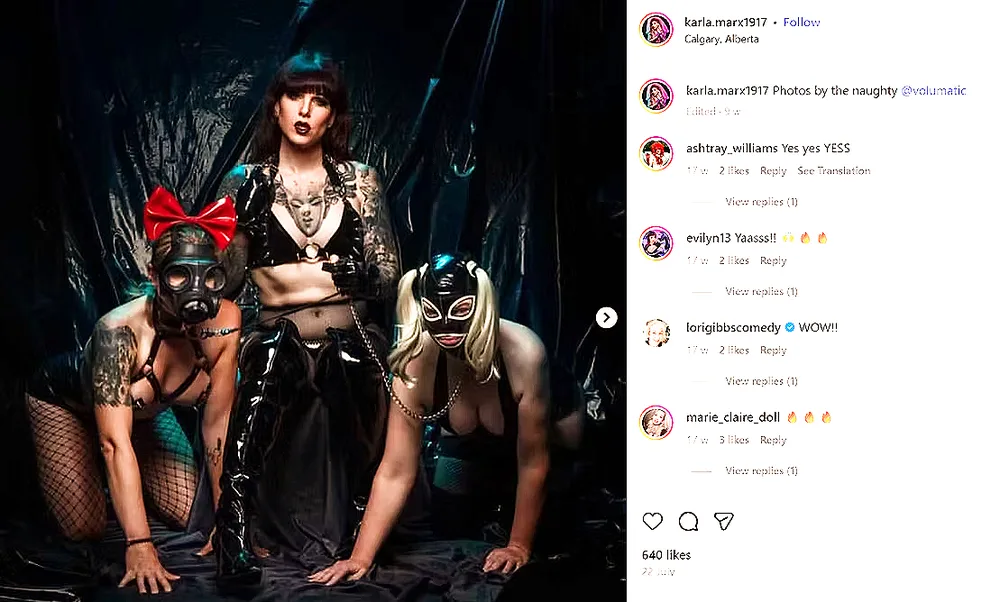
Original source: https://www.instagram.com/p/DMaYtBVxDMF/
Johnstone’s case may be a bit sadder. One of the final questions of the evening was “What brings you joy?”
Johnstone’s answer was, “Not hating myself.” And his voice cracked a bit as he said it.
His answer leads to the inevitable question:
Of the mountain of misery unloaded on Canadian women and children in the last five years in the name of gender, how much has been due to the unwillingness of this one man to accept himself as gay?
Perhaps we could all pitch in to Make Fae Just Gay, so that never again does anyone have to Ask a Trans Person Anything.
Enjoying Gender Dissent?
Why not make a one-off donation to support our work?
We are funded entirely by readers like you.
AFTERWORDS by Toni Vonk
About That “No-Recording” Request
At the beginning of the Ottawa Ask a Trans Person Anything evening, audience members were asked not to make recordings:
Bucholtz: (referring to Johnstone and himself) “We’re being recorded. That’s in case we happen to say something clever today that we would like to be aware of. However, to the fellow at the back, we would ask people not to record or be on their phones. This way, it creates a kind of more intimate space where we can share more freely and openly.
“So, we will not be recording you in any way. We’re recording ourselves, and we ask that you please don’t record us either.”
However, throughout the event, whenever an audience member asked a question, the operator of the large video camera positioned in front of the stage turned the camera toward the audience, panned across those in attendance and focused on the questioner. Bucholtz’s assurance that audience members would not be recorded therefore appears inconsistent with what occurred.
Gender Dissent subsequently received an unofficial audio recording of the event. After careful editorial consideration, we have decided to publish a limited number of brief excerpts where they materially support our reporting and serve the public interest. This was a publicly promoted event addressing matters of public policy, medical treatment and child safeguarding. Accurately documenting consequential statements made by prominent advocates allows readers to hear the speakers’ own words and to assess their meaning, tone and context for themselves.
The excerpts are presented for the purposes of reporting, criticism and public-interest commentary. They have not been deceptively edited or rearranged and focus on the featured speakers. Identifying information concerning private audience members has been omitted. The brief quotations printed below each clip heading are highlights only, not complete transcripts; the accompanying audio clips contain the longer excerpts and provide additional context.
Recording information and attribution: The following excerpts were recorded at the Ask a Trans Person Anything event held at SAW Gallery in Ottawa on August 24, 2026. The featured speakers are Fae Johnstone and Victoria Bucholtz. All excerpts are reproduced for the purposes of reporting, criticism and public-interest commentary.
Clip 1: Fae Johnstone − Some folks disagree with us
“We’ve also had folks who disagree with us and ask us hard questions, and that has been actually a really interesting part of the tour experience.”
Clip 2: Victoria Bucholtz — Women are not being harmed in change rooms
“…the statistics demonstrate that we don’t have an increased rate of crime or violence or anything like that to show that there is some kind of threat posed by trans women or non-binary people in those spaces.”
Clip 3: Fae Johnstone — They are coming for our Charter rights
“…they are using, you know, trans as a Trojan horse, so that they [gender identity critics] can put in the rationale that they’re [people with a gender identity] going to strip some people of their Charter-protected rights, so that they can then come for the Charter-protected rights of others.”
Clip 4: Victoria Bucholtz — Male trans-identified athletes do not have a competitive advantage
“… you can’t just throw on a bikini and jump in a pool and suddenly compete. There are very strict guidelines that you have to maintain for your hormone levels, for how long this has to be done. There’s multiple studies. There literally were two more this year that came out that demonstrated that trans women generally do not have any kind of discernible advantage.”
Clip 5: Fae Johnstone and Victoria Bucholtz — About the women they refused entry, and, their refusing to answer questions
FJ: “…the third was indeed Mia Hughes, who is best known for association with one of the international anti-trans organisations, and she also writes for the far right, or what I would describe as far-right publications. And again, it was, we’re not going to be allowing her into the space because she will shift the environment…”
VB: “It’s also, you can ask us questions. It doesn’t mean that we’re going to answer. So. There are some questions, that we’ll say, we’re not going to answer that. And the framing of your question… I don’t agree with, and so I don’t think we’re going to be able to have a productive exchange.”
Clip 6: Fae Johnstone — Lesbians and feminists are our biggest supporters
“If you look at survey data, you will note that lesbians are, by and large, the most supportive of the trans community within our broader umbrella. You will also note that women are much more supportive writ large than men are. You will also note that women’s organisations across the City of Ottawa and across the country vehemently reject the narrative that is being pushed by some folks in this space… but that is NOT the feminist stance on this issue. At least, it is not the stance of feminist organisations in Ottawa or across Canada.”
Clip 7: Victoria Bucholtz — The 20-30-30-20 spectrum
“…and so, the reason why we host this is for basically the 20, the 30, and the 30. The far 20, that has their minds made up about trans people… we will talk to them to a point when it becomes no longer productive. We draw a line with that, and that’s that. So why we’re doing this is for those other groups, for people who agree with the principles of transness and inclusion, and diversity, equity. We’re here to talk to those people because it’s often nice to kind of have a discussion about what’s going on within the movement.”
Clip 8: Fae Johnstone — That “gal” in Moncton and about that infamous tweet
“So, I think about the gal in Moncton who came in with her own notes, and you know, I sent out a stupid tweet about five years ago. It was one that I would not tweet out again. I was angry, and the words that we say, like, the questions that we get, the, the language that we use matters, and will be understood differently. And when I say the word, ‘TERF,’ I do not mean, you know, an average gal who is opposed to, or doesn’t like, or doesn’t agree with trans people or trans movements. I mean the people who drown my mentions with the term ‘paedophile’ and ‘groomer.’”
Clip 9: Victoria Bucholtz — Pronoun circles and early childhood development
“I would default to experts … there are so many people who do early childhood development. I do not. So, I would default to those experts, those people who spend time doing something I refuse to do, which is spend time around children.”
Clip 10: Fae Johnstone — I wore a shirt with a knife on it
“Like, I literally wore a shirt that had, like, ‘Protect Trans Kids’ on it, and it had a knife… but it wasn’t, like, ‘I’m gonna stab you,’ knife. It was like, I like to wear black. You can see that I’m goth-coded, and I wanted a shirt with an edgy knife on it, and that was used to describe me as, like, threatening violence, and still is.”
Clip 11: Fae Johnstone — We got on our high horse and tried to lecture the world
“But we also need to be able to explain these things in a commonsense way. And that’s where we screwed up. Because I think we got on our high horse and we imagined that we could lecture the world and sometimes shame the world. Shame the world into getting on board. And that built a resentment.”
Clip 12: Fae Johnstone — Our movement is not encouraging transition
“… a lot of the rhetoric and a lot of the, like, argument around, that, like, we’re gonna like, trans the gay away, is based off of a debunked study, right? And it was actually [Dr. Ken] Zuckerberg in Toronto, who I think, it was data over, like, some series of decades, and it has been, like, widely discredited.”
Clip 13: Fae Johnstone — Medical safeguards and wrap-around care for children
“…and so my fundamental belief is, that if we invested in the services and supports that are chronically neglected, so that every kid, regardless of gender identity, who is experiencing gender dysphoria or might be exploring transition, that they are getting the wrap-around care, the psychiatric support, the physicians that they need, and then beyond that, it is none of our business what decisions other families and young people are making in consultation with their family physicians and their health providers.”
Clip 14: Fae Johnstone and Victoria Bucholtz — A lesson in 2SLGBTQIA+ terminology
FJ: “That’s the other fun thing, is like, I’m sitting beside a lesbian [audience laughter], and so there is this, idea, like, if you love, like, the idea… Like, a lot of trans people, like, identify as queer, identify as gay or lesbian or bisexual. And so, it is like, you can be both, you can be either. There is a lot of freedom in that space, and it really is about being able to find the words that best describe you…”
VB: “So sometimes, like, I’ll talk about, like, ‘oh, all my friends are gay.’ I don’t mean that they’re gay men. I just mean that they’re not straight or that they’re not cis. There’s this other demographic − you’re going to love them, women − who said, ‘Why do we use a male-centered term to refer to everyone? Why can’t we have a more neutral one?’ So we reclaimed a slur, ‘queer,’ as an umbrella term, and queer can be applied to anyone who is not heterosexual and not cisgender. So that would include everyone in the 2SLGBTQIA+ community.”
Clip 15: Victoria Bucholtz — Give children a buffet of supports
“…think of it more as offering a buffet of supports. Let them pick the ones that that kid needs, because it might not be the ones that you think. You’re like, ‘I think you need this,’ and the kid’s like, ‘I really hate Brussels sprouts. I want these,’ you know. So just make sure there’s options. Make sure there’s an atmosphere of trying things: ‘It’s okay. I’m not going to be judgmental.’ And then let them come to you, and I think that would work out really well.
Clip 16: Fae Johnstone — I trust doctors
“I reject the idea that there is some sort of conspiracy or an agenda there, because I guarantee you that trans people are not funded by Big Pharma. I sometimes wish that we were, because, Lord Jesus, it would help.”
Clip 17: Victoria Bucholtz — I always liked girls
“I always liked girls. I just didn’t know why that felt gay. And then later, as I transitioned, I realized, ‘Oh, the gay part was me.’”
Clip 18: Fae Johnstone — People will misgender me
“I do believe in trying to be nice to people. I do believe in people’s [good] intentions and trying to dialogue across difference. And people are going to make mistakes. People will misgender me. I don’t yell at them. I say, ‘Hey, babes, why?’ And then we move on.”
Clip 19: Victoria Bucholtz — I love femininity
“I just, I love femininity. I love all aspects of it. And so being able to, like, I love design, and I love aesthetics and things like that. So being able to finally play with this aesthetic for myself, instead of just dressing all of my girlfriends immaculately, that’s been really nice.”
Clip 20: Fae Johnstone — I like not hating myself
“…when I think back to who I was and what I was before, like, the self-loathing ran deep. And when I contrast that with who I am now… Everything’s not perfect… But I like taking a moment and being like, ‘Shit, 12-year-old me would have probably bullied this [me] and been so scared, and I am so happy this is where I am.’ I love taking a moment to bask in that a little bit.”
Now About That Follow-up Press Conference
The Johnstone/Bucholtz AATPA component of the Trans Canada Tour advertised 21 dates. Johnstone told the Ottawa audience that they had actually held more than 50 events over the summer months. Related events included those titled Queer Movement Townhall, Politics with a Drag Queen, and PRIDE and POLITICS.
That’s a lot of government-funded travel, accommodation and per diem.
That’s also a lot of Canadian audience to have been cultivating and preparing for the next trick that they had up their sleeve.
One month after the Ottawa installation of AATPA, the “boys were back in town” with a collection of fully clothed friends from Queer Momentum, TransAction Alberta, the Enchanté Network, Saskatoon Pride and Pride Corner.
The boys are back in town.https://t.co/aLlOXDJHWV pic.twitter.com/XrswUsrrkg
— Miss Mass Formation🇨🇦 (@missmassform) September 28, 2026
Having booked Room 135-B through the Canadian Parliamentary Press Gallery Secretariat, as any individual or organization can, on September 28, 2026, the Johnstone/Bucholtz gang conducted a 27-minute news conference in which they called for a House of Commons committee to investigate what they characterized as the suspension of Charter rights for transgender-identifying youth in Alberta and Saskatchewan.
They objected to provincial policies concerning parental consent for children’s names and pronouns at school, restrictions on medical transition procedures for minors, and eligibility rules for female sports. They also alleged that these measures were contributing to bullying, deteriorating mental health and families leaving the two provinces.
Although the conference was presented principally as a demand for a parliamentary inquiry, it also included a direct appeal for continued − and increased − federal funding.
During the final question-and-answer period, a reporter asked whether the organizers had spoken with the Liberal government or Women and Gender Equality Minister Rechie Valdez about supporting an inquiry.
Johnstone responded by urging Ottawa to renew the federal 2SLGBTQI+ Action Plan, stating that it provided resources “to address hate” and “to support and sustain community organizations.”

https://www.cpac.ca/headline-politics/episode/transgender-advocates-call-for-inquiry-into-alta-sask-laws
And About the MONEY – SO MUCH MONEY
Eight days later, on October 6, 2026, a coalition led by Johnstone of more than 40 2SLGBTQIA+ organizations, held a lobbying day on Parliament Hill, during which the coalition called upon Ottawa to provide $450 million over five years − $90 million annually − to renew and expand the federal 2SLGBTQIA+ Action Plan.
The demand represents a substantial increase over the $100 million committed to the original five-year plan. Johnstone said the requested funding would build the capacity of community organizations and finance frontline services, housing, healthcare, refugee assistance, international advocacy and economic-development initiatives.
The activists spent the week meeting with MPs, senators and representatives of ministers’ offices ahead of the 2026 federal budget (Budget 2026 is scheduled for fall 2026 but has not yet been tabled).
Now, guess how many meetings with MPs, senators or representatives of ministers’ offices have been arranged for women seeking the restoration of their sex-based Charter rights, and the protection of Canadian children from the harms that gender identity ideology is inflicting upon children’s minds and bodies.
Then guess how much federal funding has been provided to support their advocacy.
If you guessed ZERO meetings and ZILCH dollars, congratulations − you understand how “equality” works in Canada.
Enjoying Gender Dissent?
Why not make a one-off donation to support our work?
We are funded entirely by readers like you.


