


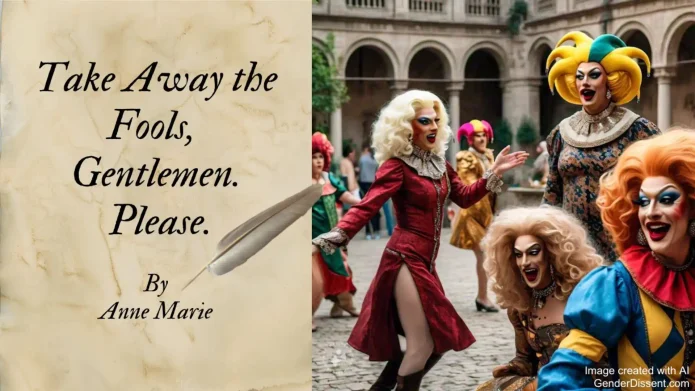
“We are trapped, at this moment, in a never-ending time of Carnival, of chaos,
in a hall of mirrors that distorts nature and human life.”
I can always count on France to give me yet another way to think about the madness that is “gender,” and my trip this fall was no exception. The impetus this time was a visit to the temporary exhibit at the Louvre museum, entitled Figures du Fou, which can be translated a couple of different ways into English, because in French it is a play on words—fou can be translated as fool, crazy person, or just madness.
In the exhibit we take a trip through time, beginning with the marginalia of illustrated manuscripts of Medieval times, which showed fools, based upon interpretations in the Bible, as those who reject God, who reject truth, who challenge the natural order of the universe. In these early images we see both foolish individuals, and imaginary monsters (also depicted in sculpture, like gargoyles on cathedrals).
As I continued through the works of art, interpretations began to change. Actual people began to appear, depicted in portraits, and woodcuts, drawings and prints. Real fools had a role to play in society, especially in elite spaces like royal courts. Kings, queens, dukes and other elites kept both “natural” fools (mentally challenged, or mentally ill, individuals) and “artificial” fools, or jesters, as part of their entourages.

This painting, by the “Master of 1537,” shows a fool “closing his eyes” to something.
One reading of this image is that an over abundance of tolerance creates a proliferation of evil.
Fools played so many roles throughout the Middle Ages and into the Renaissance that it would be impossible for me to sum them all up here, and that’s not the point of this essay anyway, but to name just a few, fools demonstrated the perils of lust, hubris, and challenging the natural order. In art and in life, they existed both for entertainment (especially in situations and times of social disorder, like Carnival, which anticipated the privations of Lent), and to warn against the consequences of “foolishness,” or sin. Occasionally they reflected the silliness, or poor judgment, of their great masters, and made them reconsider. Like King Lear’s fool. Or Lady Olivia’s fool in Twelfth Night. (“The more fool, madonna, to mourn for your brother’s soul, being in heaven. Take away the fool, gentlemen.”)
“Les fous” also symbolized people’s fear of mental instability, or MADNESS. There was even a tradition that fools were a breed apart, literally. Fools were often depicted hatching nests full of eggs, from which more fools would be born. These mad fools were different from ordinary humans, born of female mothers. I like to think of this as a medieval recognition that to deny the reality of human sexual reproduction, and the importance of our sexed bodies, is simply madness.

15th century painting inspired by Hieronymus Bosch.
A bunch of fools playing music in an egg (because that is where they come from).
Message: When the wise, or authorities, like the monk and the nun, give themselves over to envy and vice, they become fools.
And madness, of course, is the shorthand many of us use today to describe the cultural moment we are in with regard to “gender.”
I mentioned the role fools played during the “upside down” times like Carnival. During such times, people enjoyed seeing young clerics boss cardinals around, the rich serving the poor, and fools venerated as wise men. And yes, sometimes men and women reversed roles as well. But it was all in fun, for the sake of comedy. Everyone understood this, and no one expected that such role reversal would continue after its appointed time. Chaos would revert to order. Life as they knew it would continue.

16th century painting by Martin van Cleve.
Beggars wear cardinals’ hats, and pin fox tails to their tunics to mimic ermine of royal robes.
Clearly, social change does take place over time. Obviously, no modern woman thinks that we should revert to the limited sex roles of the Middle Ages. But as I wandered through the pictorial world of madness, and sometimes horror, that these artists of the “fous” created, I began to contemplate the idea that we are trapped, at this moment (especially in countries like Canada, New Zealand, Belgium, and now Germany, where gender self-identification is the law of the land), in a never-ending time of Carnival, of chaos, a hall of mirrors that distorts nature and human life. We just can’t escape the distortion.
It’s “hate” to say men aren’t women. You’re a bigot if you don’t think men should be able to destroy women’s sport. Rapists in women’s prisons? How can you object to that? Transwomen are women, after all. But, but, those who cling to material reality say, what about science? Biology says men’s bodies are stronger, and faster, than women’s, that we don’t know the long-term effects of the chemical castration drugs used to “pause” puberty, and that young people’s brains don’t finish developing until their twenties. Statistics says that “transwomen” convicted of crimes continue male patterns of criminal offense.
“The science is settled!” scream back the denizens of upside down world. “No debate!”
We can all feel, I think, that the times, they are a-startin’ to change. I really do think so. More and more people are protesting that they don’t wish to live in clown world anymore. They are sick of being asked to pretend that a tiny percentage of men with a fetish or indoctrinated young people should control the speech of everyone else in the world. And yet, and yet…
Enjoying Gender Dissent?
Why not make a one-off donation to support our work?
We are funded entirely by readers like you.
This week I went to lunch with friends here in Paris who absolutely refused to believe me when I attempted to describe the laws in Canada. When I told them that there were rapists in women’s prisons throughout North America. These people have been my close friends for almost 10 years and they seriously didn’t believe me. They could not understand how I could either tell such shocking lies, or be so stupid as to believe some kind of right-wing propaganda. So I started citing reports. Statistics. Specific laws and judgments. I could tell they still didn’t believe me. How, I asked myself, do we escape this madness?

16th century decoration illustrating the foolishness of a wise man (Aristotle) who is seduced and humiliated by the mistress/wife of his student Alexander.
Moral: even the wise can be turned into fools.
So I appealed to authority. French doctors. French doctors, I said, do not support the mutilation of children in the name of “gender” affirmation. “Mais bien sûr!” they replied. In the United States, however, I told them, a recent report states that more than 12,000 minors have had such mutilating treatments paid for by their insurance companies. Many more have paid privately for the same horrific results.
They simply stared, their forks in mid air. If French doctors are aware of this, and are against it, that’s another thing altogether, I felt them thinking.
Clown world is not a nice place to live. I don’t particularly enjoy making people understand that it is now our home. And this particular clown world, with this particular band of “fous” in charge is not even a nice place to visit. It removes so much of the fun we used to enjoy in role reversal. I remember when my sons were much younger, one Halloween they and their friends dressed up as girls. Dresses, wigs and make-up, it was a scream. One of them, an actor, played a woman, à la Kids in the Hall, in a variety of theatrical presentations. My husband once did a screamingly funny send up of Meryl Streep in Mamma Mia. Again, so, so funny.
We used to respond to men dressed as women with laughter. If was for fun, for comedy. No one took it seriously. Everyone knew life would go back to normal. Dave Foley and Bruce McCulloch would take off the dresses and be themselves again. But right now, in this moment of madness, when the “fous” run the world, it just isn’t funny. As long as those of us who cling to material reality refuse to give in, refuse to be compelled, refuse to admire the emperor’s clothes, there is hope. I do believe it. I do believe it’s true.

19th century painting by Polish artist Jan Matejko.
The jester mourns the loss of a Polish city to the Russians, while the courtiers dance. Matejko uses this image of a jester at the Polish court in 1514, to show that again, the fool can be wise and the elites can be fools.
Enjoying Gender Dissent?
Why not make a one-off donation to support our work?
We are funded entirely by readers like you.


