


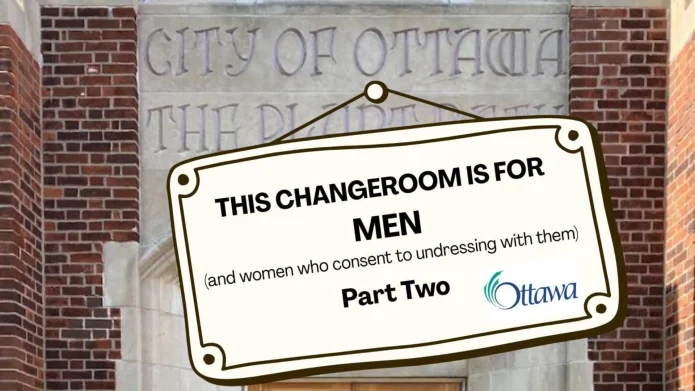
Ottawa Resident’s Exchange with City Staff Confirms Males Permitted to Use Women’s and Girls’ Changerooms
In Part One of this story, we published a series of correspondence between a Concerned Resident of Ottawa and City staff in which the Resident attempts to explain that “inclusion” of men in women’s spaces will compromise women’s ability to use those spaces. The staff respond with universal DEI talking points that show little engagement with the issue while explaining that the policies of the Women and Gender Equity Strategy “are firmly rooted in human rights legislation, shaped by the voices of the community, informed by lived experience, and guided by Council direction and evidence-based data [which] ensure our work is equitable, inclusive, and reflective of a collective vision that supports all individuals across our city.”
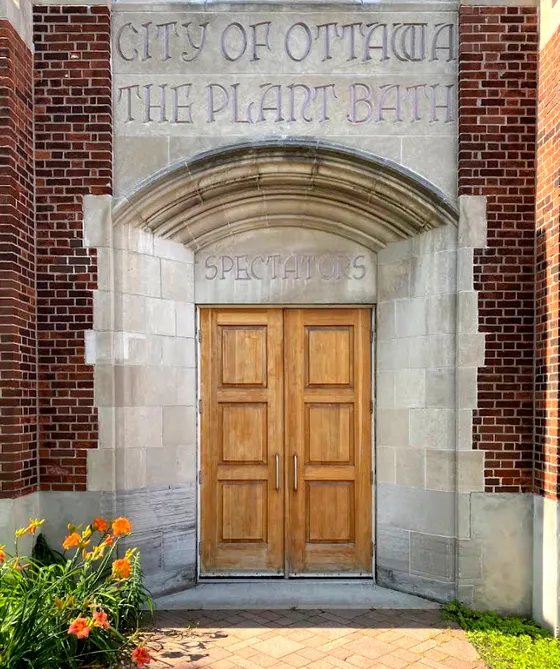
As Concerned Ottawa Resident was beginning to despair of ever making city staff see how far they had already gone in forfeiting women’s spaces under the banner of human rights, the most amazing, and unfortunate, of coincidences took place in the women’s changeroom of the Plant Recreation Centre (formerly the Plant Bath).
Here in Part Two, for the record, is the continuing email exchange between Concerned Resident of Ottawa and even more City employees.
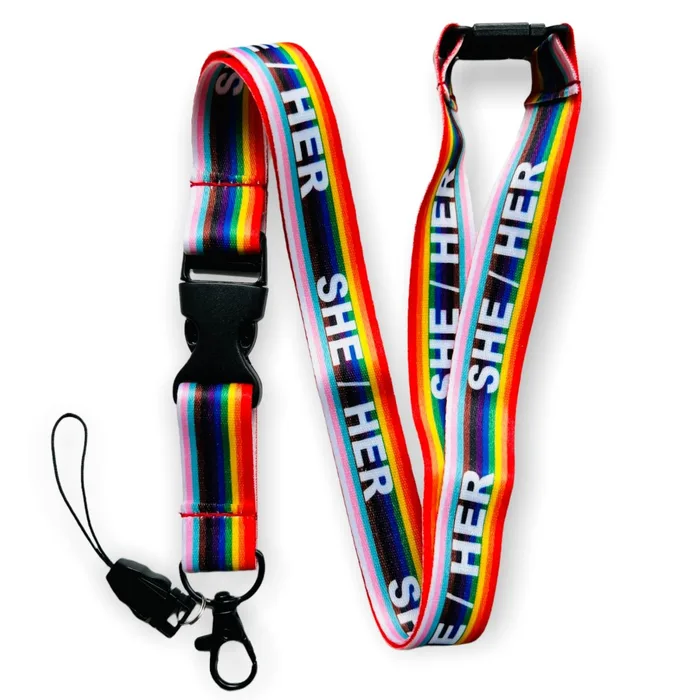
BEWARE THE SHE/HER LANYARD
Thursday, July 31 2025
Dear Sonia and Meagan [CC to Charles Séguin, Recreation Supervisor, Plant Recreation Centre]
As a follow-up to our meeting on Wednesday, July 30, when you inquired as to whether there were any examples of men in Ottawa availing themselves of women’s changing facilities, I [learned about an incident involving a trans-identified man in the women’s changeroom at the Plant Recreation Centre]:
.. a naked woman in visible distress, and two young girls having their counsellors hold up towels for them to change behind … [A] man, named [withheld]—apparently a staff member—wears a she/her lanyard. Staff said that [withheld] is a “biological woman,” just tall … It’s been policy for two years—there have been other complaints.
M Séguin,
Could you confirm that the Plant Bath welcomes all men into women’s changing facilities provided that the men have a gender identity? We are attempting to get signage at Ottawa swimming pools clarifying that women’s change rooms are now open to men, and that women should only use the pools at their own risk.
Hoping for a very speedy response on this, as we are in the midst of swim season and we are not prepared to compromise the safety, dignity and privacy of women and girls.
Bear in mind that our city facilities are meant to be used by women from a broad range of cultures, many who do not take lightly sharing changing facilities with men. If such women are to be pushed out to maintain male rights to access our facilities, please make this abundantly clear on the door to the change room, and send me a copy once this signage has been posted.
Concerned Ottawa Resident
Related:
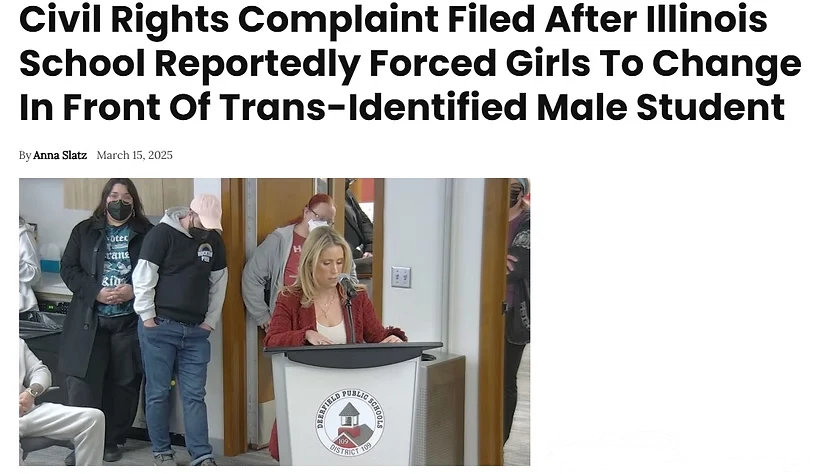
Source: https://tinyurl.com/yw9924ev
Tuesday, August 5, 2025
Dear Madam,
Thank you for sharing this follow-up and for bringing this matter to our attention. We understand the sensitivity of the concerns outlined in the message you received. As a next step, I will be reaching out to Recreation, Cultural and Facility Services to better understand the existing policy and its implementation at Plant Bath.
It is important that we gather accurate information and ensure that all voices are heard with regards to this situation.
We will keep you updated as we learn more.
Sonia Luberti
she/her/elle
(A)Director, Gender and Race Equity, Inclusion, Indigenous Relations
Community and Social Services Department
City of Ottawa
Enjoying Gender Dissent?
Why not make a one-off donation to support our work?
We are funded entirely by readers like you.
From “Women and Gender Equity Strategy approved at Council“, 2021
Donna Gray, City of Ottawa General Manager of Community and Social Services:
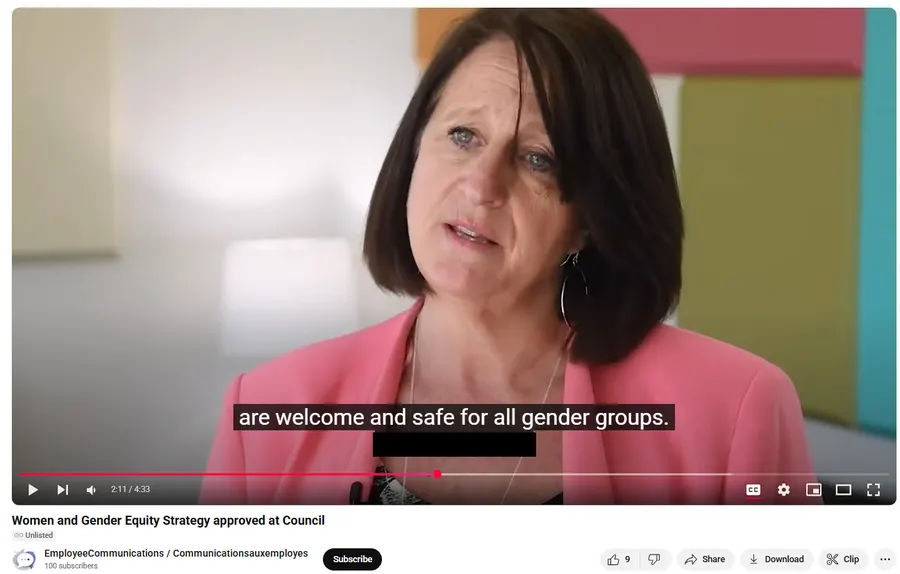
Donna Gray @1:45: … during this first phase we’ll be focusing on some of the most important challenges that women face … ensuring that women are able to partake in recreation … ensuring our City workplaces and facilities are welcome and safe for all gender groups … to make our facilities more inclusive and safer [by] adopting universal washrooms.
Wednesday, August 6, 2025
Good afternoon Madam,
Sonia Luberti passed along some questions you have about the City’s recreation facilities.
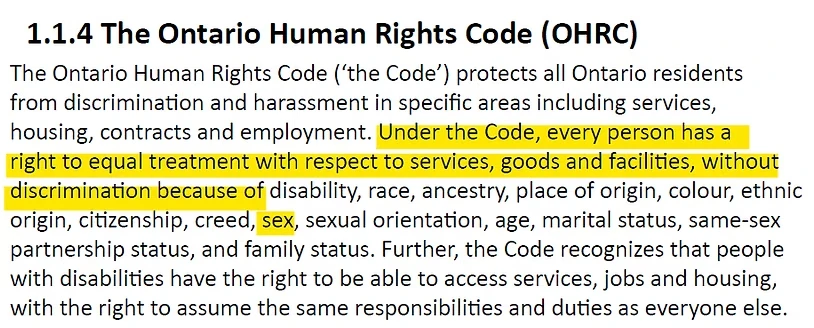
The City of Ottawa strives to provide welcoming, comforting, and inclusive spaces to all residents within our facilities. Discrimination based on gender identity or expression is explicitly prohibited under the Ontario Human Rights Code, and the City is dedicated to upholding these rights within our facilities.
As outlined by the Ontario Human Rights Commission, provincial law protects the rights of trans individuals, including their right to access facilities that align with their gender identity. I understand that this may cause some individuals to feel uncomfortable, and I want to acknowledge those concerns. To support the comfort and dignity of all facility users, we offer a universal changeroom option at many locations. These changerooms feature private cubicles, eliminating nudity in shared spaces. This approach has been in place for more than two decades and is appreciated by our clients since it provides options and flexibility for caregivers of young children, caregivers for the elderly and persons with disabilities or those with specific individual needs.
For information on facilities with gender neutral changerooms, you can use the search tool on Ottawa.ca: Place listing | City of Ottawa. Of our 20 indoor pools, whether stand-alone or part of a larger complex, 14 currently have a designated universal changeroom. This is largely due to the age of certain facilities and the design standards in place at the time they were built. It is now standard practice to include gender neutral changerooms in all new recreation facilities. At locations without a dedicated universal changeroom, staff can arrange alternative solutions to support clients requiring additional privacy or accessibility. These arrangements may not always be indicated by signage since they are coordinated and customized directly with on-site staff based on a client’s needs.
As part of the Women and Gender Equity Strategy, the City committed to installing gender-inclusive signage on all single-stall accessible washrooms in front-facing recreation centres and library facilities. Multiple signage options were studied including those used in other municipalities, as well as the private sector, in consultation with the department’s Women and Gender Equity Specialist. An accessible design which removes any reference to gender, or gender identification, with the use of a toilet symbol was selected. All identified front-facing, single-stall, accessible washrooms in recreation and library facilities have now received the new signage. This same approach has been implemented at City Hall.
The Ontario Building Code 2025, O. Reg. 163/24 and O. Reg. 5/25 adopts the National Building Code of Canada 2020 with Ontario specific amendments. When building a new facility or modifying an existing one, the City of Ottawa is required to follow the Building Code Requirements for access to universal washrooms (section 3.8.3.12 of OBC 2024) as well as O. Reg 191/11 Integrated Accessibility Standards which forms part of the Accessibility for Ontarians with Disabilities Act (AODA). Recreation facilities must provide separate washrooms for males and females, unless gender-neutral or universal washrooms are provided that meet privacy and accessibility standards. A universal washroom is defined as a fully accessible and barrier-free washroom that anyone can use irrespective of gender or orientation.
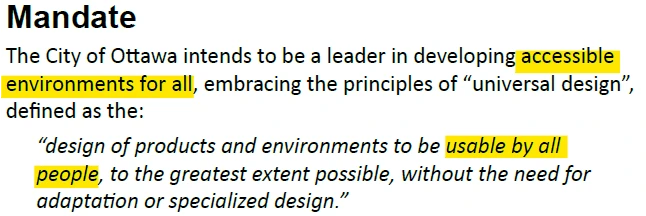
In addition to provincial legislation, the City of Ottawa Accessibility Design Standards 2015 (COADS 2015), page 104; requires the City to provide at least one universal washroom for 1-3 storeys building and two universal washrooms for 4-6 storeys building; with some exceptions for retrofits. Section 6.8. on page 180, speaks to changeroom requirements within recreation facilities and outlines provisions for universal and gendered changerooms.
I hope this response provides the information you were looking for.
All the best,
Katie O’Sullivan
Program Manager, Operational Projects
Recreation, Cultural and Facility Services Department
City of Ottawa
Gender Dissent reviewed the references provided by Katie O’Sullivan:
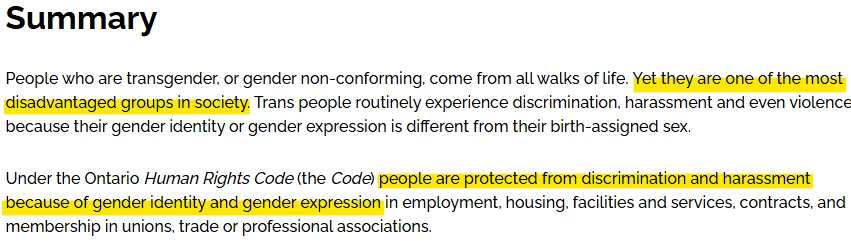
From the Ontario Human Rights Commission Policy on preventing discrimination because of gender identity and gender expression, released April 14, 2014:
From City of Ottawa Accessibility Design Standards – Second Edition, November 2015:
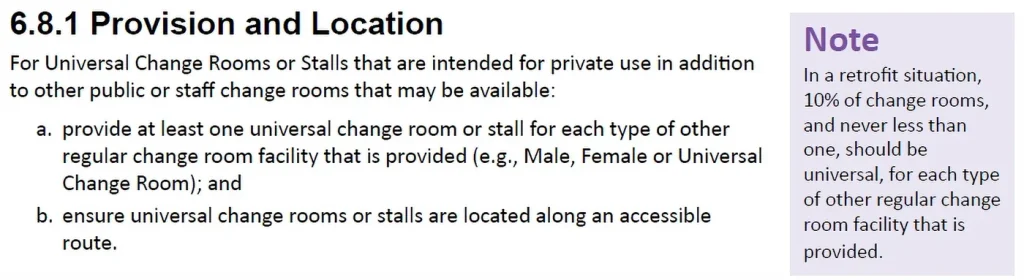
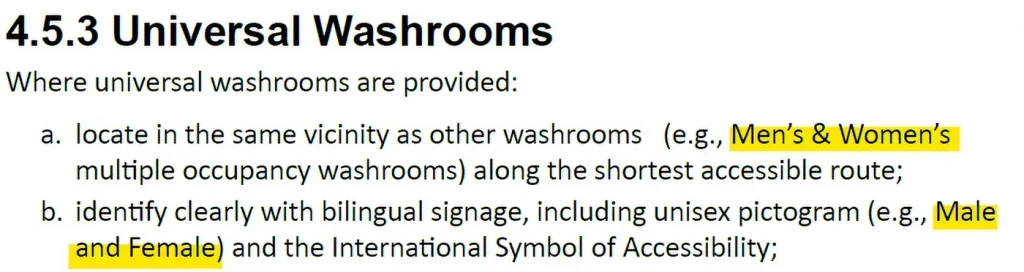
Gender Dissent located this City of Ottawa Advisory, released in 2021, that applies to the design and use of gender-inclusive washrooms:

Wednesday, August 6, 2025
Dear Ms. O’Sullivan,
Thank you for this information.
Many women are not willing to share toilets and change rooms with men, even if those men identify as wanting access to women’s spaces.
If the city wanted to include women in recreational and civic life, it would maintain single-sex spaces for women and girls and ask men to stay out.
Men with gender identities who do not wish to use the men’s spaces could be directed toward the gender-neutral options that you have outlined.
The Ontario Human Rights Code prohibits discrimination based on an individual having a gender identity. Luckily in Ontario, people with gender identities have always enjoyed exactly the same rights as all other Ontarians.
What the OHRC does not do, is bestow EXTRA human rights on individuals based on gender identities. It does not bestow on men the right to access women’s spaces based on their “identity”.
If the city is going to persist in interpreting “inclusion” to mean that women have to welcome men in their bathrooms and change rooms, many women will self-exclude from these spaces. This is particularly true of elderly, disabled, newcomer or otherwise vulnerable women.
This is not an architectural problem. It is a problem of conflicting human rights: do women have the right to set their own boundaries of privacy, dignity and safety, or are women props in a world where male identities prevail as the premier human rights claim?
We can push women out of their own spaces. It’s not hard to persuade women to stay home and regard themselves as second-class citizens.
The city has picked a side and the only task left to do is to update signage indicating that no bathrooms and change rooms are off-limits to men, and that women who don’t like this state of affairs should stay home.
Concerned Ottawa Resident
Related:
Enjoying Gender Dissent?
Why not make a one-off donation to support our work?
We are funded entirely by readers like you.
Wednesday, August 5, 2025
Dear Madam,
Thank you for taking the time to inquire about a member of our community’s experience here at Plant Recreation Centre. I have taken the time today to respond to their concern directly, and hope that reply has clarified our position. We do take the comfort and safety of our clients and staff seriously, and understanding people’s various perspectives helps us to build policy and create inclusive and safe spaces for all.
Discrimination based on gender identity or expression is explicitly prohibited under the Ontario Human Rights Code, and we are dedicated to upholding these rights within our City including our aquatic facilities. As directed by law and the Ontario Human Rights Commission, the City of Ottawa does not discriminate. This includes but is not limited to discrimination against individuals for their sex assigned at birth and their gender identity. As such, clients are directed to use the changeroom they feel most comfortable in, and are not required to use any particular space. This human right is not reserved for men or for women, but rather afforded to all and has resulted in a diverse range of clients and staff alike using changerooms based on their gender identity.
13.4.1 Access based on lived gender identity
Access to washrooms is a basic physical need at the core of human dignity for everyone. Yet washrooms cause significant barriers for trans people and are one of the public spaces they avoid most.[117]. The Code allows for restriction of services or facilities to persons of the same sex for reason of “public decency.”[118] Facilities such as washrooms, change rooms and locker rooms are typically segregated based on sex. Trans people have the right to access these facilities based on their lived gender identity.
An organization’s washroom facilities and any related policy should not negatively affect trans people. A trans person who identifies and lives as a man should have access to the men’s washrooms and change rooms. A trans person who identifies and lives as a woman should have access to the women’s washrooms and change rooms.
13.4.2 Accommodation and inclusive design
A trans person does not need to “ask” to use the washroom. They have the right to use the one that matches their lived gender identity. Some people, however, may need accommodation, temporary or otherwise, to access washrooms, change-rooms or other type of sex-segregated facility.
Here at Plant, individuals seeking extra privacy based on their preference, level of comfort, or belief system have access to private changing stalls in all changerooms, as well as a universal changeroom which features no nudity in public areas. Individuals wishing to change in privacy always have that option at their disposal.
Thank you again for bringing your concerns to our attention. While we appreciate that this is not the answer you were seeking, the City does not support gender based harassment of staff or members of the public and considers this matter closed.
Thank you,
Charlie
Charles Séguin (he/him | il/lui)
Recreation Supervisor, Plant Recreation Centre=
Recreation, Cultural, and Facility Services
City of Ottawa
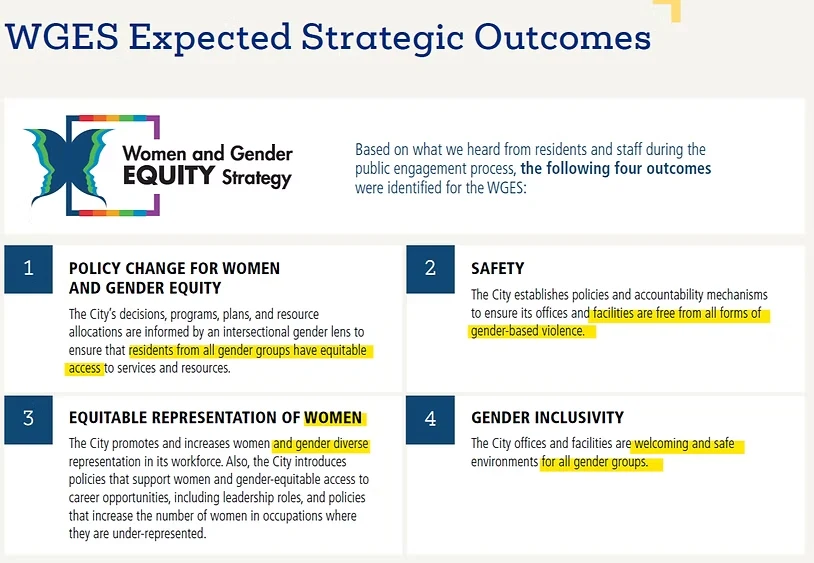
From City of Ottawa Women and Gender Equity Strategy, 2021:
Wednesday, August 5, 2025
Dear M Séguin,
Thank you for taking the time to clarify that the Plant Bath in Ottawa allows unlimited male access to female change rooms.
For years, women’s rights campaigners have been unsuccessful at explaining to legislators, media and human rights professionals that observance of Gender Ideology on the part of public institutions destroys women’s rights by allowing any men into women’s spaces. Your email is a splendid clarification that the City of Ottawa does not attempt to maintain any change rooms or bathrooms as “women-only”.
As you have pointed out, many men “feel most comfortable” in women’s spaces, and their right to use these spaces has trumped women’s discomfort in changing clothes in front of men. It is a conflict of rights claim, and you have made the case that men won this battle long before most women realized that our spaces were open for the taking.
The Ontario human rights legislation that you have quoted leaves some wiggle room for service providers to furnish third spaces for clients who do not want to use the facilities that match their sex. Many DEI professionals assume that men with gender identities are small in number and do not wish to violate the privacy of women by demanding access to women’s spaces. Many well-meaning people assume that gender-identified men are discreetly using these third spaces and cause no threat to women.
However you have made clear in your email that in fact all men are eligible to declare a gender identity, and the gender identity is the ticket into the women’s facilities.
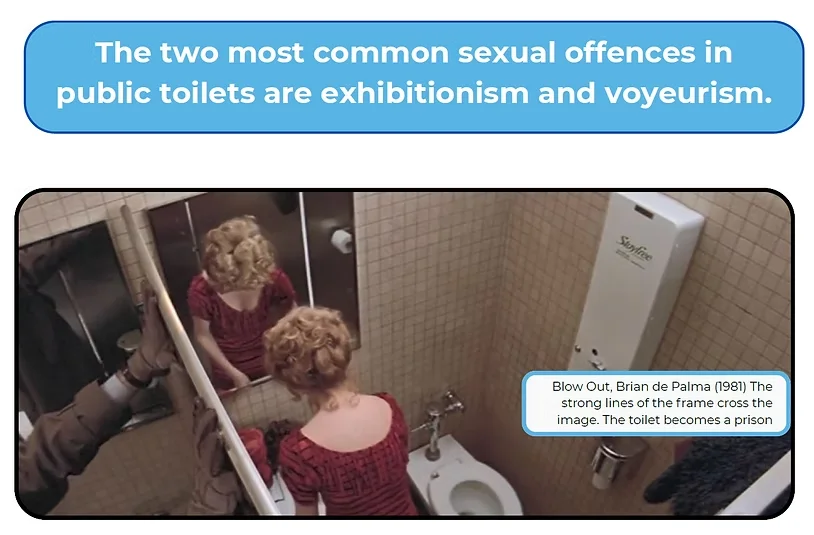
Many women will not share toilets, change rooms or sleeping facilities with unfamiliar males. This is borne of a wariness for safety, privacy and dignity that comes from women having to protect themselves from much larger, stronger and more sexually aggressive males.
As a service provider, you are free to exercise your authority to marginalize women by forfeiting our spaces to men with gender demands. What you cannot do, is pretend to be offering a single-sex service, all the while surreptitiously ushering men into women’s spaces. You have no right to consent on behalf of these women to undress in the presence of males
It is absolutely paramount that you update your signage immediately at Plant Bath to indicate that there are now two change rooms: one for men, and the other for men and any women who consent to changing with men. Anything less than this is sexual assault.
You are confident that you are solidly backed up by Ontario Human Rights legislation, so you will have no hesitation whatsoever in updating your signage. Stand tall as you bargain away women’s spaces on our behalf. Because inclusion.
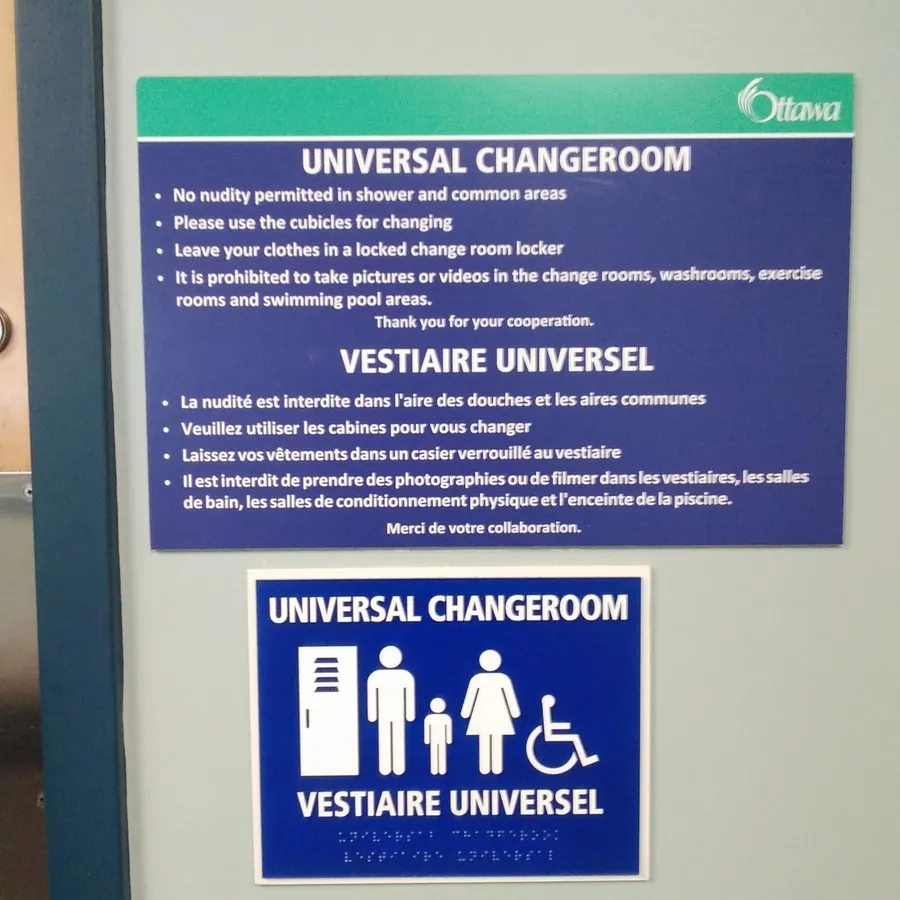
Photo credit: Haelie Zersch
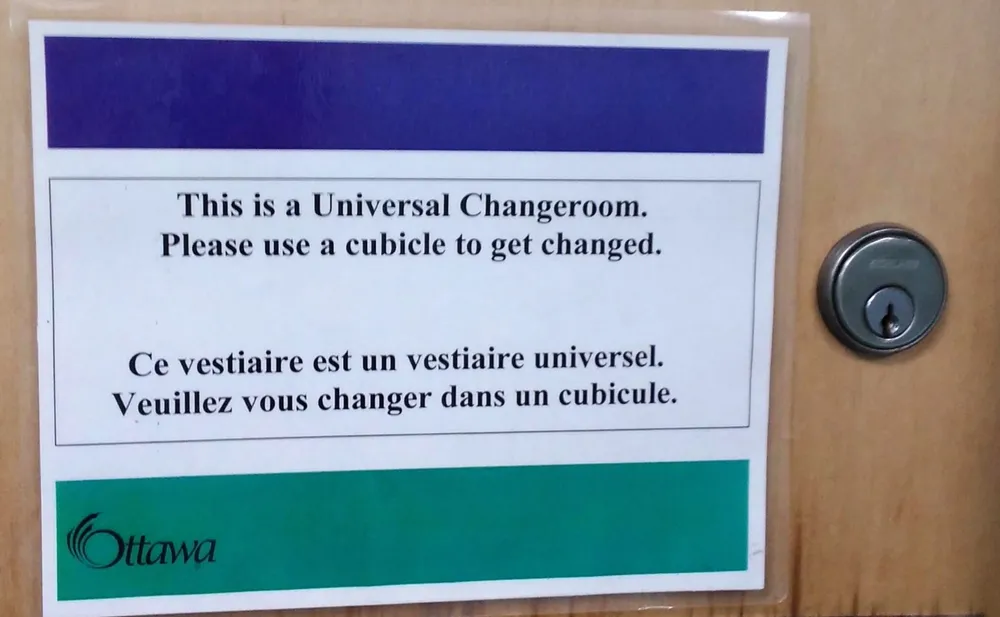
Photo credit: Haelie Zersch
Thank you also for clarifying that the “City….considers this matter closed.” Silencing women who object to men in their spaces has been the only scaffolding that has upheld the absurdity of Gender Ideology since it burst onto the human rights stage in 2015.
Women have finally understood what is being asked of them, and the answer is “no”.
Whether the “no” takes the form of women retreating from recreational facilities in fear and humiliation, or whether it takes the form of engaging with legislators, only time will tell.
📢 Help us be a voice for vulnerable women
— Canadian Women's Sex-Based Rights (@cawsbar) July 15, 2025
Our current fundraising effort focuses on our Charter challenge to protect incarcerated women. Will you help?
Donate nowhttps://t.co/iURlpuJPvu
Find out more in the next post ⤵️ pic.twitter.com/7zy3iyo53J
Allowing men into women’s spaces is a major shift in the practice of basic human rights, and it is one that has never been subjected to any public discussion. #NoDebate. But we are no longer living in 2021, and it is getting more difficult to threaten women into silence by destroying livelihoods and reputations for the crime of standing up for single-sex spaces.
A nurse with a spotless track record gets fined and suspended for pointing out there are two genders, and for praising world renowned author & women's rights advocate @jk_rowling.
— Pierre Poilievre (@PierrePoilievre) August 20, 2025
This is authoritarian censorship.
We must restore free speech and free thinking in a free country. https://t.co/OoAvE0YF74
Happy to engage more on this topic with anyone who would like to see an Ottawa where women are allowed their own spaces, free of male presence and male demands.
Concerned Ottawa Resident
CC
charles.seguin@ottawa.ca, sonia.luberti@ottawa.ca, Mark.Sutcliffe@ottawa.ca, Ariel.Troster@ottawa.ca, rechie.valdez@parl.gc.ca, WAGE.Info.FEGC@wage-fegc.gc.ca, info@ottawapolice.ca, cbcnewsottawa@cbc.ca, news@cfra.com, newsroom@thecanadianpress.com, ottawanews@ctv.ca
Enjoying Gender Dissent?
Why not make a one-off donation to support our work?
We are funded entirely by readers like you.


