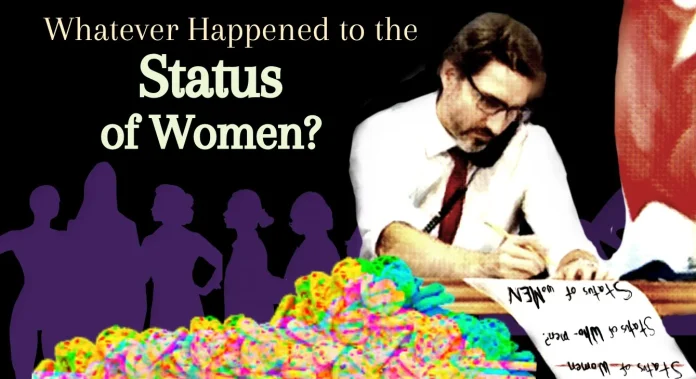
Whatever happened to the Status of Women?

Written by

Date Published

Last Updated

When the Canadian government changed Status of Women to Women and Gender Equality in 2017, it erased women from the very departmental agency created for them. This was less than 50 years since the word “woman” first appeared in the name of a departmental agency.

The Office of the Coordinator, Status of Women, was created in 1971 within the Privy Council Office. It became a departmental agency of the federal government on April 1, 1976, when it became known as Status of Women Canada (SWC). This was a timely move — women were becoming more visible as they moved from the home into the universities and careers.

SWC was responsible for providing strategic policy advice, championing and mentoring, commemorating, and funding women’s programs. The goal was to increase their economic security and prosperity, end violence against women and girls, empower women for political and community action, and encourage women’s leadership and democratic participation.

During the last year of Stephen Harper’s Conservative government, in the 2014 – 2015 Departmental Performance Report, Minister Patricia Hajdu summed up the raison d’être and responsibilities of SWC to advance equality for women in three priority areas:

  • improving women’s economic security and prosperity;
  • ending violence against women and girls; and
  • supporting the advancement and increased representation of women and girls in leadership and decision-making roles

It doesn’t even provide a definition of women for the purposes of the report. Back in 2014-2015, everyone knew a woman was an adult human female. It wasn’t even a contentious issue.

Interestingly, this report states:

To raise awareness of the key milestones in the history of women, SWC promotes commemorative dates such as: International Women’s Day (March 8), Women’s History Month (October), the International Day of the Girl (Oct 11), Persons Day (October 18) and the National Day of Remembrance and Action on Violence Against Women (December 6).

Eight years later all of these days to commemorate women have come to be high jacked by the gender ideology cult’s worship of “transwomen” who are invited to speak to women as women. More on this later.

The raison d’être of Status of Women would change after the federal Liberal Party led by Justin Trudeau won the election. Within six months of his appointment as Prime Minister, he pushed his Attorney General (Jodie Wilson-Raybould) to amend the Canadian Human Rights Act (Bill C-16 (2017)) to include gender identity and gender expression. He led this legislative change, even though he never mentioned it during his campaign stops nor in his party’s election platform. Regardless, he ensured it was included as a part of the Minister of Justice’s mandate letter.

This legislative change had never been broadly discussed or debated by the Canadian population and it wasn’t until Dr. Jordan Peterson publicly spoke out against the legislation at a Senate hearing, that it was even discussed in any terms other than glowingly by the Canadian media or Canadians at large. No one really understood what was at stake, but Dr. Peterson, as well as a few other Canadians like Meghan Murphy, could see the consequences.

Those consequences arrived the following year, when the Liberal government changed SWC to Women and Gender Equality Canada (WAGE) on December 13, 2018.

Now the WAGE mandate states:
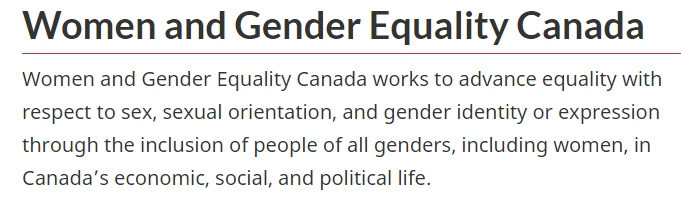
Women and Gender Equality Canada
Women and Gender Equality Canada works to advance equality with respect to sex, sexual orientation, and gender identity or expression through the inclusion of people of all genders, including women, in Canada's economic, social, and political life.

In conjunction with this status change to the federal organization, the Government of Canada also updated the definition of the term “women.” It is now a subjective gender identity instead of a biological reality. The same is true for the term ‘men’.
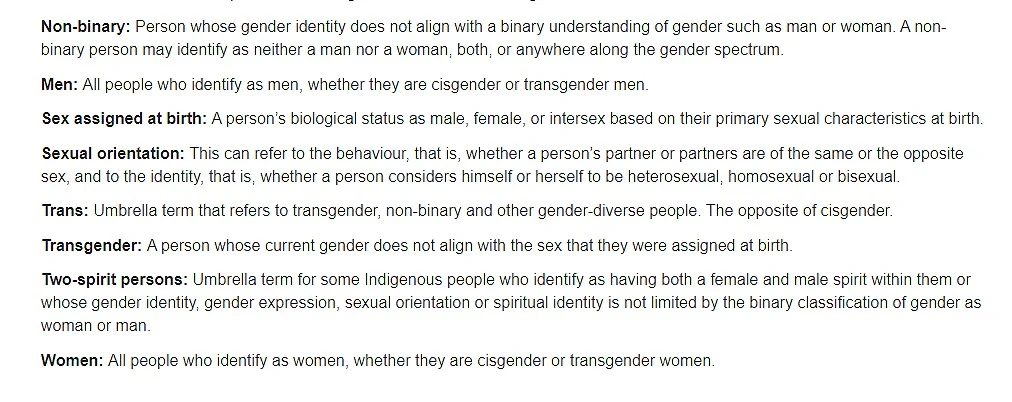
Non-binary: Person whose gender identity does not align with a binary understanding of gender such as man or woman. A non-binary person may identify as neither a man nor a woman, both, or anywhere along the gender spectrum.
Men: All people who identify as men, whether they are cisgender or transgender men.
Sex assigned at birth: A person's biological status as male, female, or intersex based on their primary sexual characteristics at birth.
Sexual orientation: This can refer to the behaviour, that is, whether a person's partner or partners are of the same or the opposite sex, and to the identity, that is, whether a person considers himself or herself to be heterosexual, homosexual or bisexual.
Trans: Umbrella term that refers to transgender, non-binary and other gender-diverse people. The opposite of cisgender.
Transgender: A person whose current gender does not align with the sex that they were assigned at birth.
Two-spirit persons: Umbrella term for some Indigenous people who identify as having both a female and male spirit within them or whose gender identity, gender expression, sexual orientation or spiritual identity is not limited by the binary classification of gender as woman or man.
Women: All people who identify as women, whether they are cisgender or transgender women.

Why weren’t Canadians asked about this changing definition? I do not believe most Canadians would be happy to know this has occurred — without any public input.

The language around adult human females (menstruator, chest feeder, birthing parent) is changing around the world, and within Canada, this change is being lead by the federal Liberal government and backed up by the NDP.

When creating policies and legislation around gender diverse Canadians, the federal government has chosen to use the terminology used by LGBTQ+ advocates and allies, and in doing so, erases the language around women and girls in order to “be kind” and “affirm” the gender identity of trans-identified people. No one is taking into consideration how this change in language is affecting women and girls.

Regardless of the impact to the sex-based rights of female Canadians, after implementing Bill C-16, the federal government developed the Modernizing the Government of Canada’s sex and gender information practices policy and are not turning back.

According to the Canadian federal government, “cis” gendered women need to identify as something they already are, because everyone has a gender identity, even if their gender aligns with their biology. They say it’s necessary for women to take the prefix “cis” to affirm trans identified people in the gender of their choice. Bill C-16 forces us to use pronouns and language we would not normally use, in order to affirm someone else’s personal identity choices. WAGE itself seems loathe to use the word “woman” to describe adult human females anywhere on their website, other than in a title (or in its own name).

In 2021 the 2SLGBTQQI+ Secretariat was moved from the Heritage Department to WAGE. The entire focus of WAGE appears to be on trans-identified Canadians, rendering the word “woman” in WAGE’s title meaningless.

Women and Violence Against Women

What is really concerning is how WAGE has turned sex-based violence into gender-based violence. While sex-based violence is obviously violence that is committed against a woman or girl because of her biological sex, Gender-based violence is defined as violence that is committed against someone based on their gender identity, gender expression or perceived gender.

Now that a woman is just a gender identity, the government can get away with using terminology like gender-based violence, when we all know the REALITY is that women are abused because of their SEX, not their gender.

The Government of Canada’s PDF on Sexual Violence: It’s not just “how things are” states that “sexual violence is a form of gender-based violence”, which is an obfuscation. Sexual violence is based on sex…it is right there in the title.

The following screenshots come from another WAGE webpage on Gender-Based Violence: It’s Not Just.

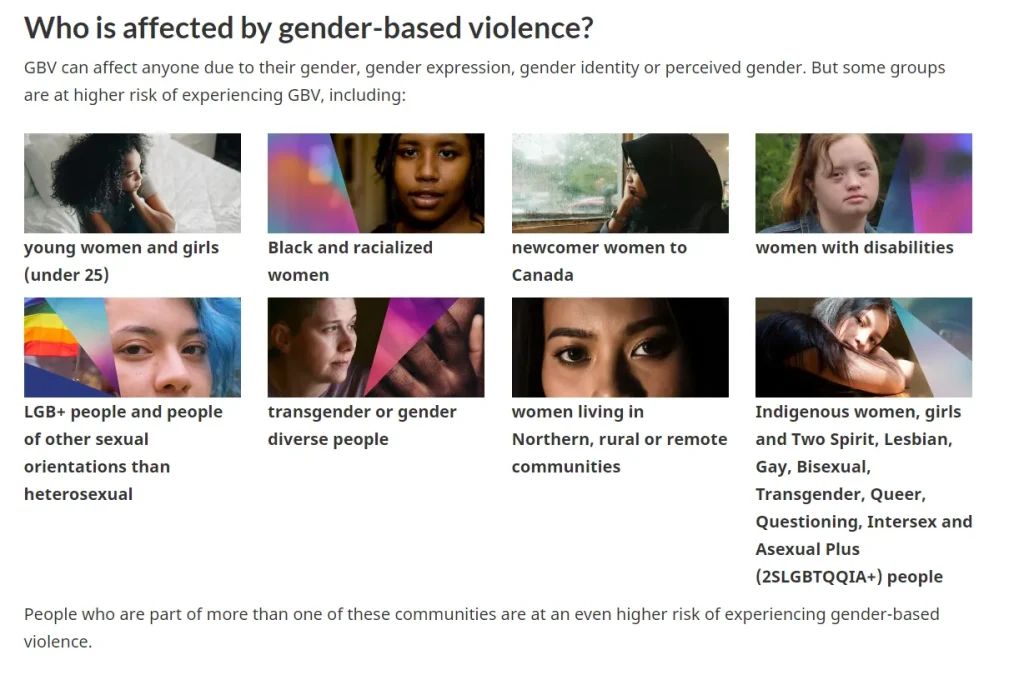
Please keep in mind that none of the statistics used in the following images is meaningful because the federal government includes men who identify as women in their statistics for women. Interestingly, all the images they use seem to be of biological females.
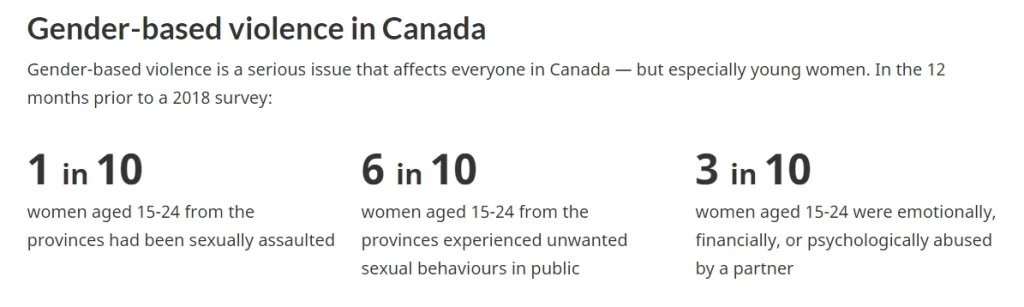
Gender-based violence in Canada
Gender-based violence is a serious issue that affects everyone in Canada — but especially young women. In the 12 months prior to a 2018 survey:
1 in 10 women aged 15-24 from the provinces had been sexually assaulted
6 in 10 women aged 15-24 from the provinces experienced unwanted sexual behaviours in public
3 in 10 women aged 15-24 were emotionally, financially, or psychologically abused by a partner
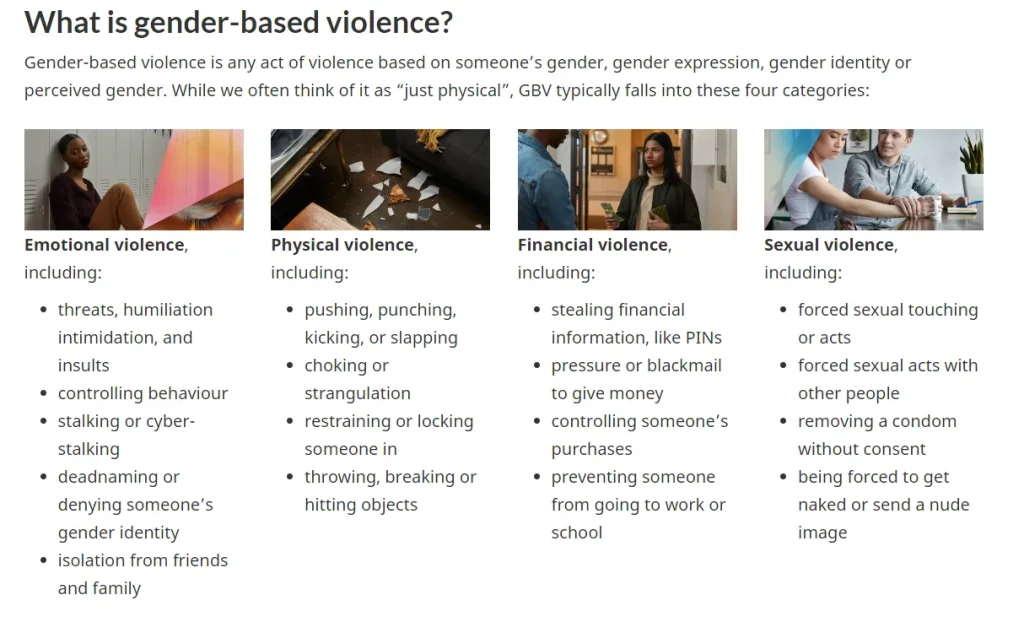
What is gender-based violence?
Gender-based violence is any act of violence based on someone's gender, gender expression, gender identity or perceived gender. While we often think of it as "just physical", GBV typically falls into these four categories:
Emotional violence, including: threats, humiliation intimidation, and insults; controlling behaviour; stalking or cyber-stalking; deadnaming or denying someone's gender identity; isolation from friends and family
Physical violence, including: pushing, punching, kicking, or slapping; choking or strangulation; restraining or locking someone in; throwing, breaking or hitting objects
Financial violence, including: stealing financial information, like PINs; pressure or blackmail to give money; controlling someone's purchases; preventing someone from going to work or school
Sexual violence, including: forced sexual touching or acts; forced sexual acts with other people; removing a condom without consent; being forced to get naked or send a nude image
Who is affected by gender-based violence?
GBV can affect anyone due to their gender, gender expression, gender identity or perceived gender. But some groups are at higher risk of experiencing GBV, including: young women and girls (under 25); Black and racialized women; newcomer women to Canada; women with disabilities; LGB+ people and people of other sexual orientations than heterosexual; transgender or gender diverse people; women living in Northern, rural or remote communities; Indigenous women, girls and Two Spirit, Lesbian, Gay, Bisexual, Transgender, Queer, Questioning, Intersex and Asexual Plus (2SLGBTQQIA+) people.
People who are part of more than one of these communities are at an even higher risk of experiencing gender-based violence.

These graphics raise some questions. Why do the Liberals need to divide “women” into eight different groups of people affected by gender based violence?

Why do they have three separate categories for:

  • LBG+ people and people of sexual orientations other than heterosexual;
  • transgender or gender diverse people and
  • Indigenous women, girls and Two Spirit, Lesbian, Gay, Bisexual, Transgender, Queer, Questioning, Intersex and Asexual Plus (2SLGBTQQIA+) people.

Why are Indigenous Women now looped in with the 2SLGBTQQIA+ people and no longer their own distinct category?

Let us take a moment to compare the sex-based violent crime statistics against female Canadians and the gender-based violent crimes against trans identified males (transwomen).

The Statistics Canada website lists the following statistics for homicides in Canada in 2021.

Total homicides: 788 (an increase of 29 homicides from 2020).

  • Gang related victims: 184
  • Indigenous victims: 190
  • Racialized victims: 247 (49% Black, 19% South Asian)
  • Women: 167

No statistics are provided for any LGBTQ+ homicides for 2021. This is very odd considering the most common refrain when asking politicians about the conflicting rights between trans-identified males (“transwomen”) and biological females, is that “transwomen” are victimized the most, which is why they need special laws and language. Yet, the government’s own statistics disprove that argument.

The following excerpt seems to be very clear:
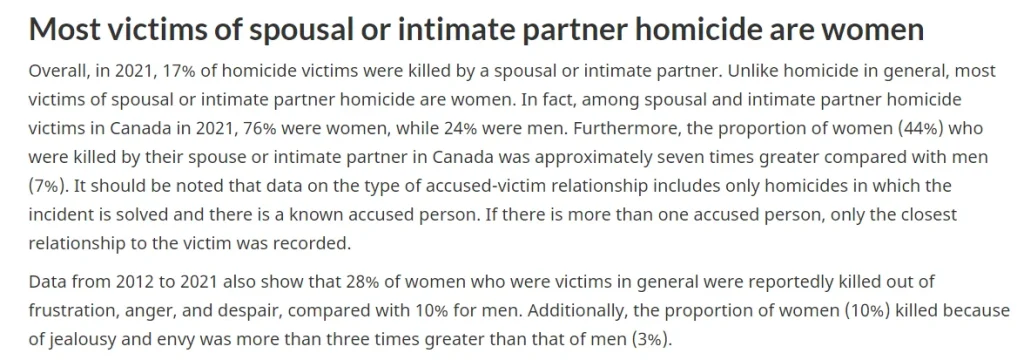
Most victims of spousal or intimate partner homicide are women
Overall, in 2021, 17% of homicide victims were killed by a spousal or intimate partner. Unlike homicide in general, most victims of spousal or intimate partner homicide are women. In fact, among spousal and intimate partner homicide victims in Canada in 2021, 76% were women, while 24% were men. Furthermore, the proportion of women (44%) who were killed by their spouse or intimate partner in Canada was approximately seven times greater compared with men (7%). It should be noted that data on the type of accused-victim relationship includes only homicides in which the incident is solved and there is a known accused person. If there is more than one accused person, only the closest relationship to the victim was recorded.
Data from 2012 to 2021 also show that 28% of women who were victims in general were reportedly killed out of frustration, anger, and despair, compared with 10% for men. Additionally, the proportion of women (10%) killed because of jealousy and envy was more than three times greater than that of men (3%).

But it is not. This page provides the following note to readers for clarity.
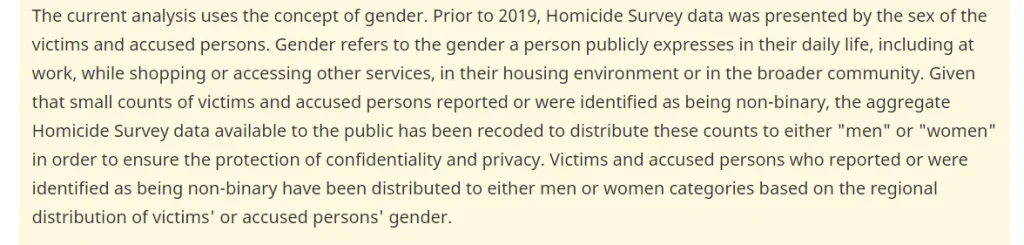
The current analysis uses the concept of gender. Prior to 2019, Homicide Survey data was presented by the sex of the victims and accused persons. Gender refers to the gender a person publicly expresses in their daily life, including at work, while shopping or accessing other services, in their housing environment or in the broader community. Given that small counts of victims and accused persons reported or were identified as being non-binary, the aggregate Homicide Survey data available to the public has been recoded to distribute these counts to either "men" or "women" in order to ensure the protection of confidentiality and privacy. Victims and accused persons who reported or were identified as being non-binary have been distributed to either men or women categories based on the regional distribution of victims' or accused persons' gender.

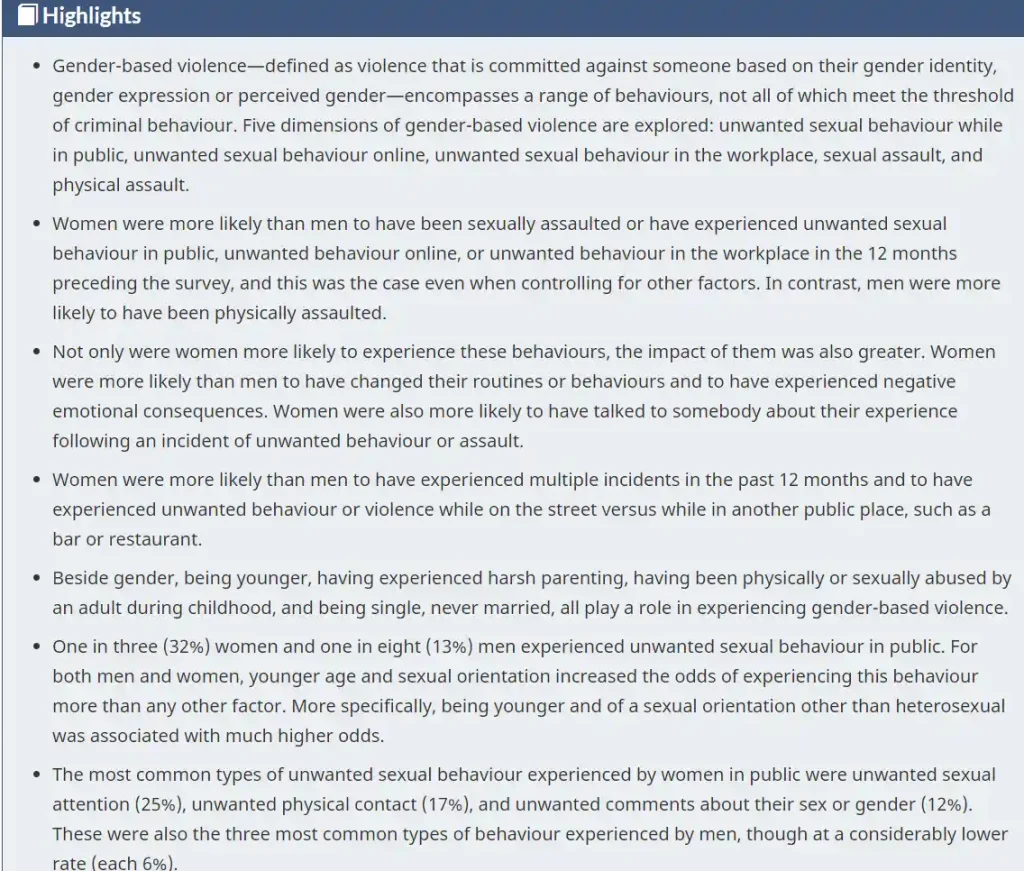
The following excerpt is from Some of the highlights from the Gender-based violence and unwanted sexual behaviour in Canada, 2018: Initial Findings from the Survey of Safety in Public and Private Spaces: (December 2019)
Highlights
Gender-based violence—defined as violence that is committed against someone based on their gender identity, gender expression or perceived gender—encompasses a range of behaviours, not all of which meet the threshold of criminal behaviour. Five dimensions of gender-based violence are explored: unwanted sexual behaviour while in public, unwanted sexual behaviour online, unwanted sexual behaviour in the workplace, sexual assault, and physical assault.
Women were more likely than men to have been sexually assaulted or have experienced unwanted sexual behaviour in public, unwanted behaviour online, or unwanted behaviour in the workplace in the 12 months preceding the survey, and this was the case even when controlling for other factors. In contrast, men were more likely to have been physically assaulted.
Not only were women more likely to experience these behaviours, the impact of them was also greater. Women were more likely than men to have changed their routines or behaviours and to have experienced negative emotional consequences. Women were also more likely to have talked to somebody about their experience following an incident of unwanted behaviour or assault.
Women were more likely than men to have experienced multiple incidents in the past 12 months and to have experienced unwanted behaviour or violence while on the street versus while in another public place, such as a bar or restaurant.
Beside gender, being younger, having experienced harsh parenting, having been physically or sexually abused by an adult during childhood, and being single, never married, all play a role in experiencing gender-based violence.
One in three (32%) women and one in eight (13%) men experienced unwanted sexual behaviour in public. For both men and women, younger age and sexual orientation increased the odds of experiencing this behaviour more than any other factor. More specifically, being younger and of a sexual orientation other than heterosexual was associated with much higher odds.
The most common types of unwanted sexual behaviour experienced by women in public were unwanted sexual attention (25%), unwanted physical contact (17%), and unwanted comments about their sex or gender (12%). These were also the three most common types of behaviour experienced by men, though at a considerably lower rate (each 6%).

This entire page ONLY mentions women and men. No LGBTQ+ statistics are provided, which again illustrates that “transwomen” and “transmen” are not their own statistical category, but are listed under the gender they identify as.

Still, the government can make a claim (shown on the sexual violence infographic) that LBG+ people are almost 3x more likely to be physically or sexually assaulted. How can they know? Does the shortened acronym mean this figure relates only to the LGB? Also, most of these assaults are indicated on surveys, not in crime statistics, which clearly show that female Canadians are at a much higher risk of violence, than LGBTQ+ people are.

The 2020 State of the Criminal Justice System: Focus on Women written by the Department of Justice states (on pages 12 and 13) the following about how gender and sex statistics are gathered in the federal government:
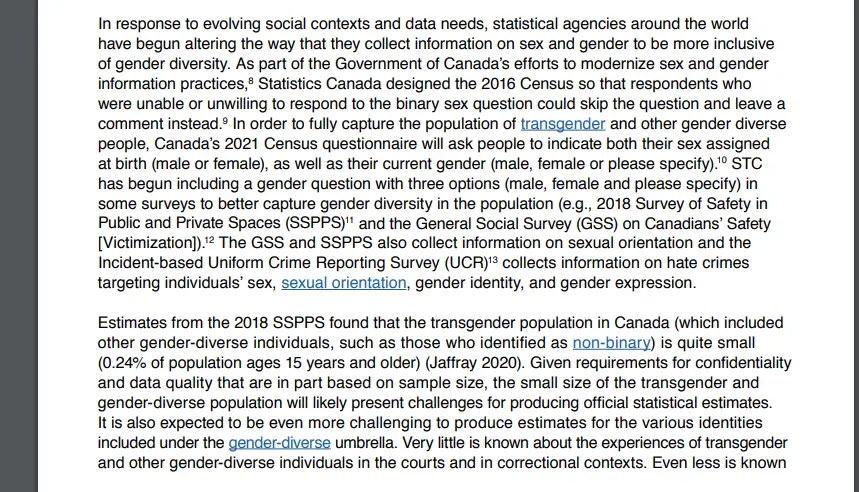
In response to evolving social contexts and data needs, statistical agencies around the world have begun altering the way that they collect information on sex and gender to be more inclusive of gender diversity. As part of the Government of Canada's efforts to modernize sex and gender information practices,⁸ Statistics Canada designed the 2016 Census so that respondents who were unable or unwilling to respond to the binary sex question could skip the question and leave a comment instead.⁹ In order to fully capture the population of transgender and other gender diverse people, Canada's 2021 Census questionnaire will ask people to indicate both their sex assigned at birth (male or female), as well as their current gender (male, female or please specify).¹⁰ STC has begun including a gender question with three options (male, female and please specify) in some surveys to better capture gender diversity in the population (e.g., 2018 Survey of Safety in Public and Private Spaces (SSPPS)¹¹ and the General Social Survey (GSS) on Canadians' Safety [Victimization]).¹² The GSS and SSPPS also collect information on sexual orientation and the Incident-based Uniform Crime Reporting Survey (UCR)¹³ collects information on hate crimes targeting individuals' sex, sexual orientation, gender identity, and gender expression.
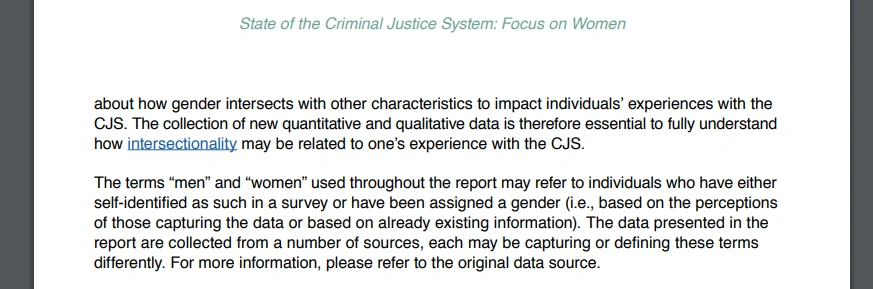
Estimates from the 2018 SSPPS found that the transgender population in Canada (which included other gender-diverse individuals, such as those who identified as non-binary) is quite small (0.24% of population ages 15 years and older) (Jaffray 2020). Given requirements for confidentiality and data quality that are in part based on sample size, the small size of the transgender and gender-diverse population will likely present challenges for producing official statistical estimates. It is also expected to be even more challenging to produce estimates for the various identities included under the gender-diverse umbrella. Very little is known about the experiences of transgender and other gender-diverse individuals in the courts and in correctional contexts. Even less is known
State of the Criminal Justice System: Focus on Women
about how gender intersects with other characteristics to impact individuals' experiences with the CJS. The collection of new quantitative and qualitative data is therefore essential to fully understand how intersectionality may be related to one's experience with the CJS.
The terms "men" and "women" used throughout the report may refer to individuals who have either self-identified as such in a survey or have been assigned a gender (i.e., based on the perceptions of those capturing the data or based on already existing information). The data presented in the report are collected from a number of sources, each may be capturing or defining these terms differently. For more information, please refer to the original data source.

And here are graphics showing rates of violence:
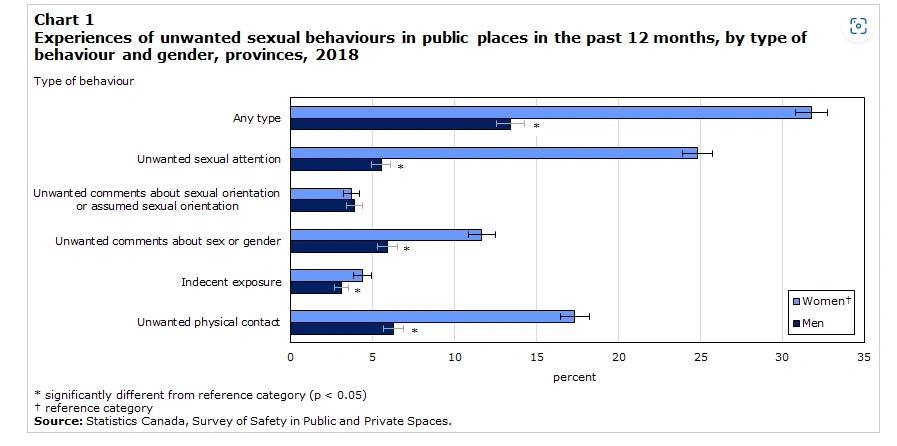
Experiences of unwanted sexual behaviours in public places in the past 12 months, by type of behaviour and gender, provinces, 2018
Type of behaviour: Any type, Unwanted sexual attention, Unwanted comments about sexual orientation or assumed sexual orientation, Unwanted comments about sex or gender, Indecent exposure, Unwanted physical contact
Legend: Women† (light blue), Men (dark navy) — percent scale 0 to 35
significantly different from reference category (p < 0.05)
† reference category
Source: Statistics Canada, Survey of Safety in Public and Private Spaces.
Notice how “women” is now a reference category (+)
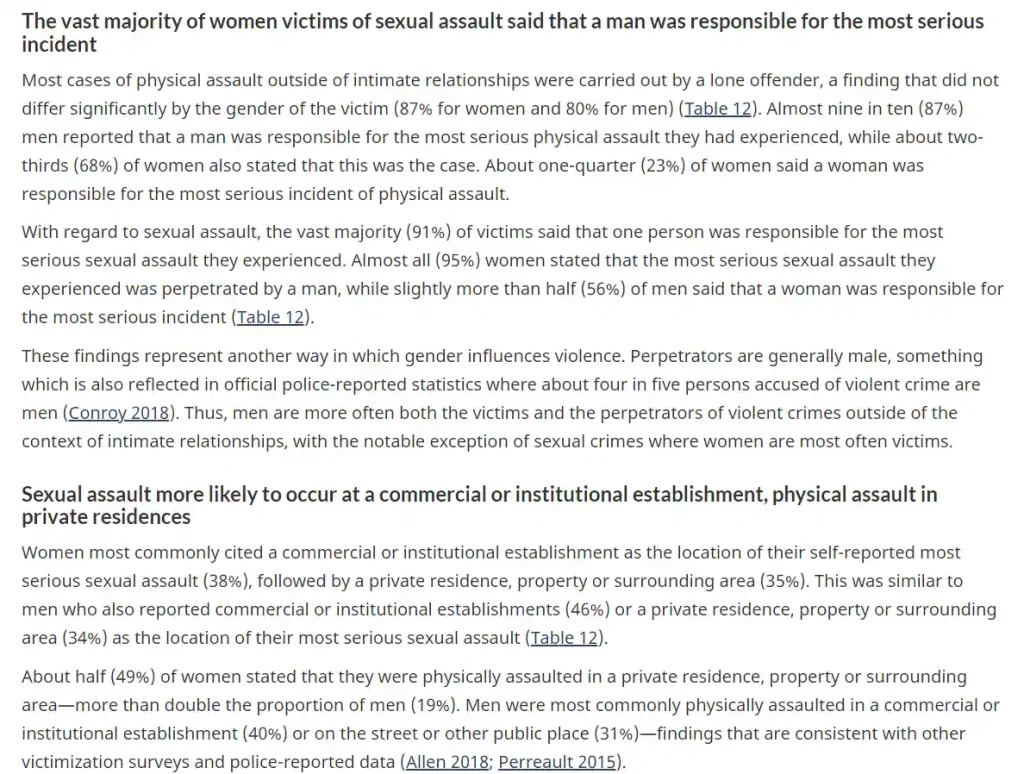
The vast majority of women victims of sexual assault said that a man was responsible for the most serious incident
Most cases of physical assault outside of intimate relationships were carried out by a lone offender, a finding that did not differ significantly by the gender of the victim (87% for women and 80% for men) (Table 12). Almost nine in ten (87%) men reported that a man was responsible for the most serious physical assault they had experienced, while about two-thirds (68%) of women also stated that this was the case. About one-quarter (23%) of women said a woman was responsible for the most serious incident of physical assault.
With regard to sexual assault, the vast majority (91%) of victims said that one person was responsible for the most serious sexual assault they experienced. Almost all (95%) women stated that the most serious sexual assault they experienced was perpetrated by a man, while slightly more than half (56%) of men said that a woman was responsible for the most serious incident (Table 12).
These findings represent another way in which gender influences violence. Perpetrators are generally male, something which is also reflected in official police-reported statistics where about four in five persons accused of violent crime are men (Conroy 2018). Thus, men are more often both the victims and the perpetrators of violent crimes outside of the context of intimate relationships, with the notable exception of sexual crimes where women are most often victims.
Sexual assault more likely to occur at a commercial or institutional establishment, physical assault in private residences
Women most commonly cited a commercial or institutional establishment as the location of their self-reported most serious sexual assault (38%), followed by a private residence, property or surrounding area (35%). This was similar to men who also reported commercial or institutional establishments (46%) or a private residence, property or surrounding area (34%) as the location of their most serious sexual assault (Table 12).
About half (49%) of women stated that they were physically assaulted in a private residence, property or surrounding area—more than double the proportion of men (19%). Men were most commonly physically assaulted in a commercial or institutional establishment (40%) or on the street or other public place (31%)—findings that are consistent with other victimization surveys and police-reported data (Allen 2018; Perreault 2015).
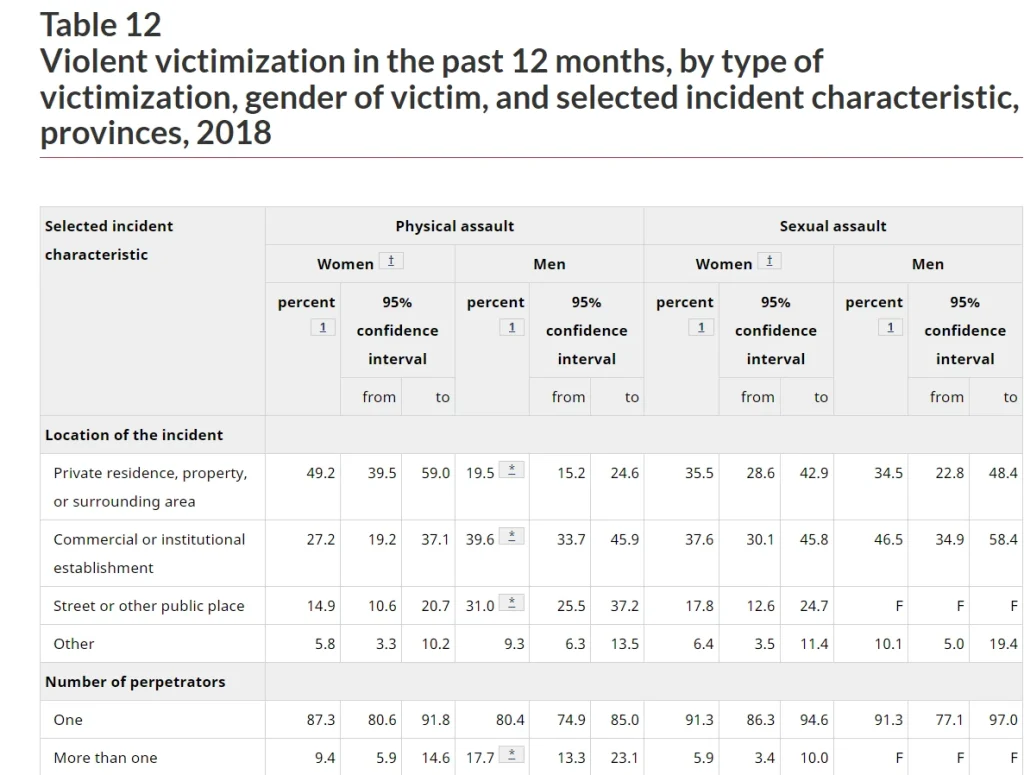
Table 12
Violent victimization in the past 12 months, by type of victimization, gender of victim, and selected incident characteristic, provinces, 2018
Location of the incident — Physical assault: Women 49.2 (39.5–59.0), Men 19.5* (15.2–24.6) | Sexual assault: Women 35.5 (28.6–42.9), Men 34.5 (22.8–48.4)
Commercial or institutional establishment — Physical assault: Women 27.2 (19.2–37.1), Men 39.6* (33.7–45.9) | Sexual assault: Women 37.6 (30.1–45.8), Men 46.5 (34.9–58.4)
Street or other public place — Physical assault: Women 14.9 (10.6–20.7), Men 31.0* (25.5–37.2) | Sexual assault: Women 17.8 (12.6–24.7), Men F (F–F)
Other — Physical assault: Women 5.8 (3.3–10.2), Men 9.3 (6.3–13.5) | Sexual assault: Women 6.4 (3.5–11.4), Men 10.1 (5.0–19.4)
Number of perpetrators
One — Physical assault: Women 87.3 (80.6–91.8), Men 80.4 (74.9–85.0) | Sexual assault: Women 91.3 (86.3–94.6), Men 91.3 (77.1–97.0)
More than one — Physical assault: Women 9.4 (5.9–14.6), Men 17.7* (13.3–23.1) | Sexual assault: Women 5.9 (3.4–10.0), Men F (F–F)
Sex of perpetrator
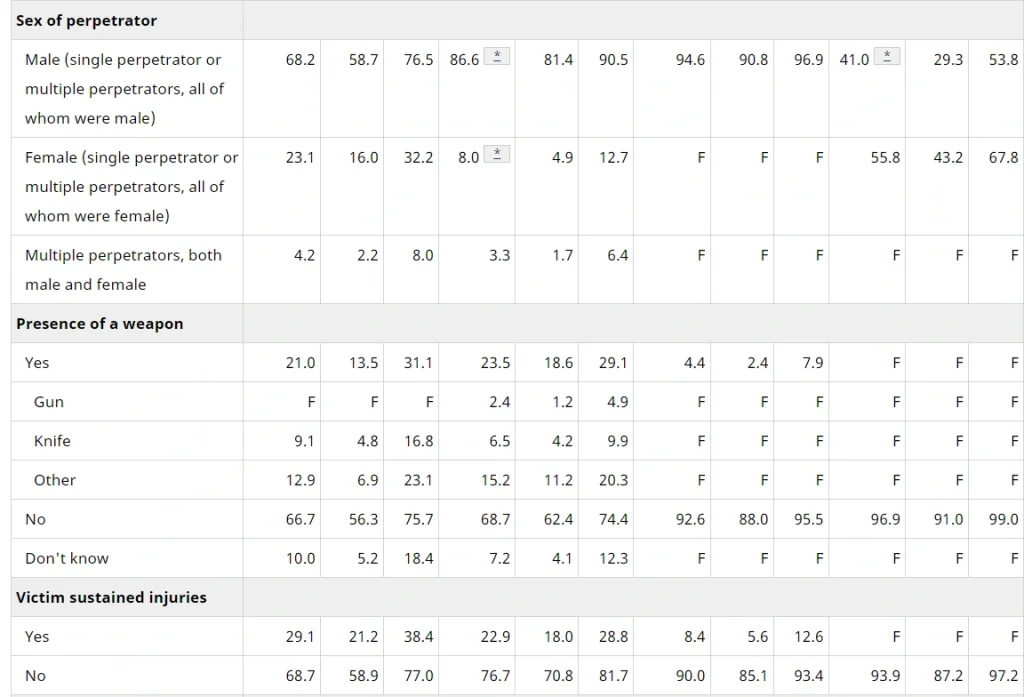
Male (single perpetrator or multiple perpetrators, all of whom were male) — Physical assault: Women 68.2 (58.7–76.5), Men 86.6* (81.4–90.5) | Sexual assault: Women 94.6 (90.8–96.9), Men 41.0* (29.3–53.8)
Female (single perpetrator or multiple perpetrators, all of whom were female) — Physical assault: Women 23.1 (16.0–32.2), Men 8.0* (4.9–12.7) | Sexual assault: Women F (F–F), Men 55.8 (43.2–67.8)
Multiple perpetrators, both male and female — Physical assault: Women 4.2 (2.2–8.0), Men 3.3 (1.7–6.4) | Sexual assault: Women F (F–F), Men F (F–F)
Presence of a weapon
Yes — Physical assault: Women 21.0 (13.5–31.1), Men 23.5 (18.6–29.1) | Sexual assault: Women 4.4 (2.4–7.9), Men F (F–F)
Gun — Physical assault: Women F (F–F), Men 2.4 (1.2–4.9) | Sexual assault: Women F, Men F
Knife — Physical assault: Women 9.1 (4.8–16.8), Men 6.5 (4.2–9.9) | Sexual assault: Women F, Men F
Other — Physical assault: Women 12.9 (6.9–23.1), Men 15.2 (11.2–20.3) | Sexual assault: Women F, Men F
No — Physical assault: Women 66.7 (56.3–75.7), Men 68.7 (62.4–74.4) | Sexual assault: Women 92.6 (88.0–95.5), Men 96.9 (91.0–99.0)
Don't know — Physical assault: Women 10.0 (5.2–18.4), Men 7.2 (4.1–12.3) | Sexual assault: Women F, Men F
Victim sustained injuries
Yes — Physical assault: Women 29.1 (21.2–38.4), Men 22.9 (18.0–28.8) | Sexual assault: Women 8.4 (5.6–12.6), Men F
No — Physical assault: Women 68.7 (58.9–77.0), Men 76.7 (70.8–81.7) | Sexual assault: Women 90.0 (85.1–93.4), Men 93.9 (87.2–97.2)
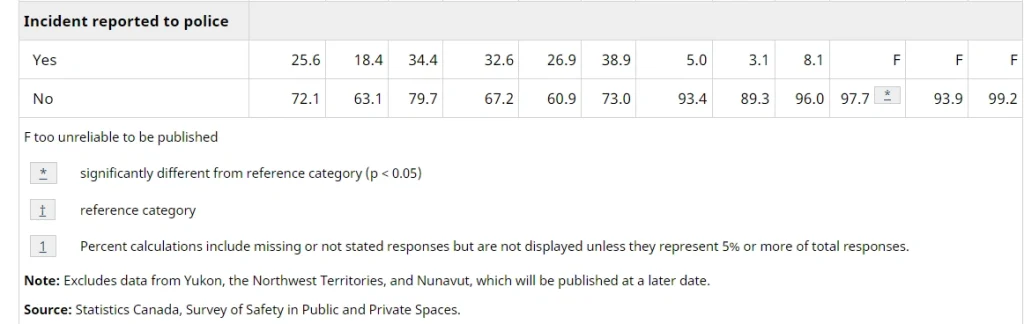
Incident reported to police
Yes — Physical assault: Women 25.6 (18.4–34.4), Men 32.6 (26.9–38.9) | Sexual assault: Women 5.0 (3.1–8.1), Men F (F–F)
No — Physical assault: Women 72.1 (63.1–79.7), Men 67.2 (60.9–73.0) | Sexual assault: Women 93.4 (89.3–96.0), Men 97.7* (93.9–99.2)
F too unreliable to be published
significantly different from reference category (p < 0.05)
‡ reference category
1 Percent calculations include missing or not stated responses but are not displayed unless they represent 5% or more of total responses.
Note: Excludes data from Yukon, the Northwest Territories, and Nunavut, which will be published at a later date.
Source: Statistics Canada, Survey of Safety in Public and Private Spaces.
Notice footnote 1 — “women” is a reference category

The Trudeau government’s own statistics show that males are violent towards females. Approximately 4.7 million women in Canada have been sexually assaulted since the age of 15. (That’s roughly one in eight). If biological females make up 50% of the 38.25 million Canadian population, that’s just over 19 million. In 2018, the Institut nationale de santé du Québec indicated that across Canada 33% of women reported being sexually assaulted. That’s 6,311,250 Canadian women!

Yet they are allowing males who identify as women, by SELF ID alone, with no medical diagnosis of gender dysphoria nor “bottom surgery” legally required, to have full unfettered access to female same sex spaces. Not only are men who self-identify as women allowed access to our bathrooms, change rooms, hospital wards, gyms, and rape crisis centres, but they have also been allowed to join sports teams, and receive women’s awards, grants and accolades.

The Minister’s Message in The 2020 State of the Criminal Justice System – Focus on Women pdf created by the Department of Justice Canada states:

This report is an important part of our efforts to report publicly on the performance of Canada’s criminal justice system. The special focus of this report is an example of how we are modernizing the use of data to inform decisions and to serve all Canadians.

This year’s report focuses on women’s perceptions of the criminal justice system, as well as their interactions with it as victims, survivors, accused and/or offenders. We know that women make up the overwhelming majority of victims of certain types of crimes and represent a growing proportion of the prison population. We also know that victimization plays an important role in many women’s experiences as offenders.

What does the Minister mean when he says “women?” What does the report mean when it indicates that “woman” is a “reference category”? Why is “man” not a reference category?

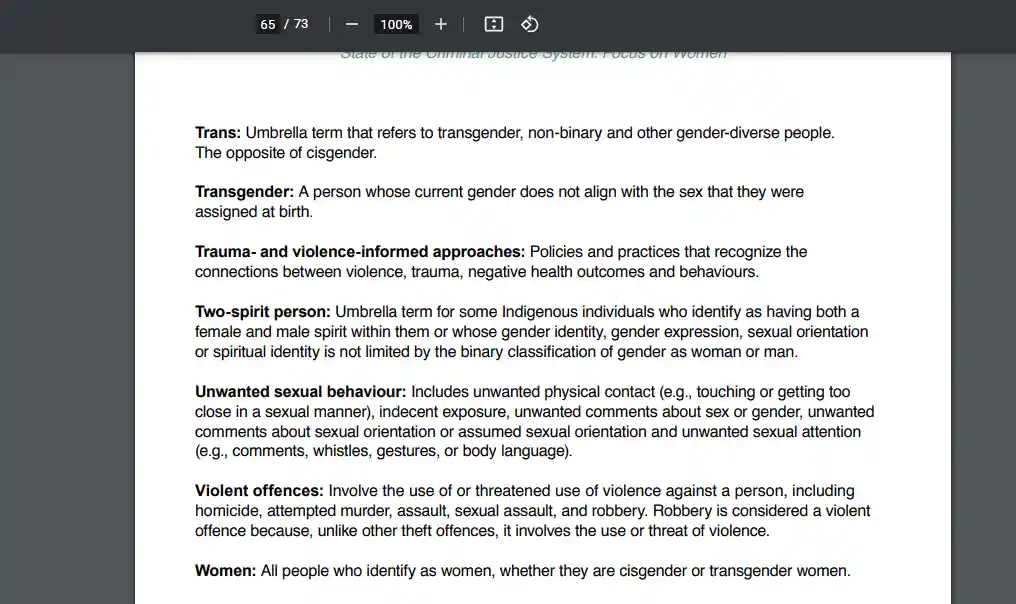
Females are currently being forced to share their living quarters with males who identify as women in federal and provincial jails and prisons across Canada, yet this government doesn’t care. In fact it was Justin Trudeau’s idea. Their modernized data is being used to obscure the many challenges faced by female Canadians. The best example of this is the following screenshot. We are just one identity of many, and the word woman is a mere reference category.

Under Annex II – Definitions (Page 65) they list the following:
[PDF page 65/73]
State of the Criminal Justice System: Focus on Women
Trans: Umbrella term that refers to transgender, non-binary and other gender-diverse people. The opposite of cisgender.
Transgender: A person whose current gender does not align with the sex that they were assigned at birth.
Trauma- and violence-informed approaches: Policies and practices that recognize the connections between violence, trauma, negative health outcomes and behaviours.
Two-spirit person: Umbrella term for some Indigenous individuals who identify as having both a female and male spirit within them or whose gender identity, gender expression, sexual orientation or spiritual identity is not limited by the binary classification of gender as woman or man.
Unwanted sexual behaviour: Includes unwanted physical contact (e.g., touching or getting too close in a sexual manner), indecent exposure, unwanted comments about sex or gender, unwanted comments about sexual orientation or assumed sexual orientation and unwanted sexual attention (e.g., comments, whistles, gestures, or body language).
Violent offences: Involve the use of or threatened use of violence against a person, including homicide, attempted murder, assault, sexual assault, and robbery. Robbery is considered a violent offence because, unlike other theft offences, it involves the use or threat of violence.
Women: All people who identify as women, whether they are cisgender or transgender women.

Gender Dissent has already documented the “lived experiences” of incarcerated females who are forced into being housed with males who identify as women.

Men Invited to Appropriate Women’s Voices

In what seems to Canadian women like a final and surely gratuitous insult, men are now invited to speak on those days designated by the old SWC for remembrance and celebration of women.

Prime Minister Trudeau, whose government is well known for saying things like, “trans women are women” and “trans rights are human rights”, cannot even dedicate International Women’s Day (March 8) to females, as he likes to say that “everyone has the chance to reach their full potential, regardless of their gender identity, race, ethnicity or religion.” Every year on this day, he proves that women are just a gender identity to him. Well, most women. I am sure he recognizes his mother, wife and daughter as biological females, who most likely won’t have to share any of their same sex spaces with biological males due to his policies.

In fact, politicians from across Canada are hosting International Women’s Day Discussion Panels that include trans identified males, like Fae Johnstone, who Gender Dissent has written about previously. He is known for his run-ins with lesbians and women who don’t think he should be allowed to speak for women.

@JenniferAnne_s shared her interaction with Fae on Twitter after confronting him for speaking at an event meant to honour slain women, at Durham College on December 6, 2022.

October is Women’s History Month in Canada but the Women’s History Month page on the WAGE website last updated the Women In Canadian History: A timeline in 2019, even though 2022 was the 30 year anniversary of Women’s History Month. Does anyone remember hearing anything about the events celebrating this milestone?

After a google search looking for federal events commemorating the 30th anniversary of Women’s History Month, all I could find was the WAGE webpage (screenshot below) dedicated to this topic that contains very little information.
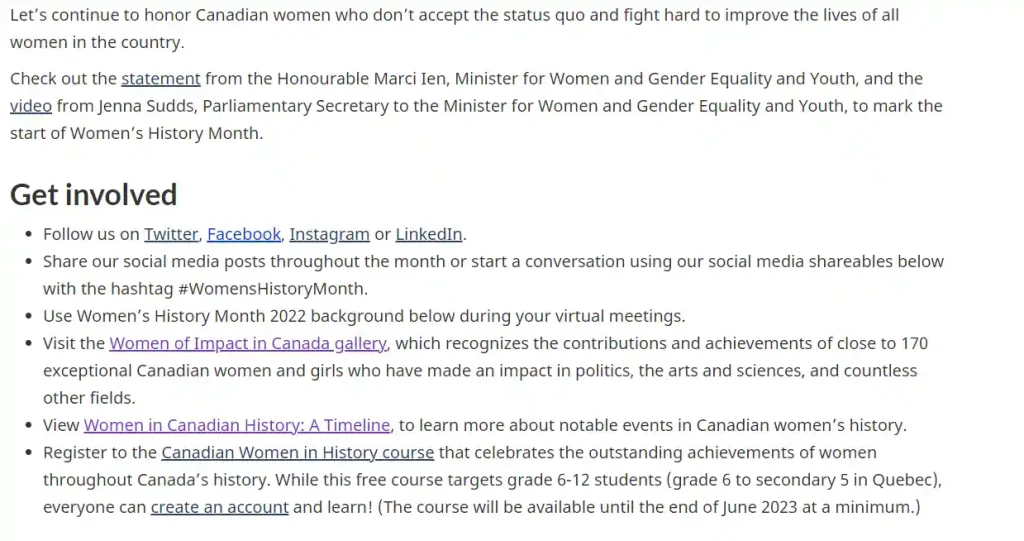
Let's continue to honor Canadian women who don't accept the status quo and fight hard to improve the lives of all women in the country.
Check out the statement from the Honourable Marci Ien, Minister for Women and Gender Equality and Youth, and the video from Jenna Sudds, Parliamentary Secretary to the Minister for Women and Gender Equality and Youth, to mark the start of Women's History Month.
Get involved
Follow us on Twitter, Facebook, Instagram or LinkedIn.
Share our social media posts throughout the month or start a conversation using our social media shareables below with the hashtag #WomensHistoryMonth.
Use Women's History Month 2022 background below during your virtual meetings.
Visit the Women of Impact in Canada gallery, which recognizes the contributions and achievements of close to 170 exceptional Canadian women and girls who have made an impact in politics, the arts and sciences, and countless other fields.
View Women in Canadian History: A Timeline, to learn more about notable events in Canadian women's history.
Register to the Canadian Women in History course that celebrates the outstanding achievements of women throughout Canada's history. While this free course targets grade 6-12 students (grade 6 to secondary 5 in Quebec), everyone can create an account and learn! (The course will be available until the end of June 2023 at a minimum.)

The opposite is true when it comes to the 2SLGBTQ+ community, although increasingly that just means “‘trans”, since lesbians and bisexual females are ignored. WAGE does not spare any expense to celebrate the host of transgender commemorations days. (November is Transgender Awareness Month, November 6 – Transgender Parent Day, November 8 – Intersex Day of Remembrance, November 13 – 19 – Transgender Awareness Week, November 20 – Transgender Day of Remembrance).

With the help of important stakeholders such as BlackRock, and the various NDP and Liberal governments across Canada, especially the federal Liberal Party, this small fringe group has been elevated into primary stakeholder status. Now, according to our federal government the only important division between humans is “lgbtq+” and “cis”. As felicia rembrandt pointed out in a previous Gender Dissent article, “That means 99.7% of us are undifferentiated, without category or class, invisible and powerless.”

As @womankind posted on Twitter:

Imagine white people who identify as black people having more legal protections than black people.

Imagine able-bodied people who identify as disabled having more legal protections than disabled people.

Now imagine men who identify as women having more legal protections than women.

This week is International Women’s Day, and the theme this year is “Every Woman Counts” – non-controversial pablum that hides the reality that, in Canada, the only “women” who count are men masquerading in an assortment of queer identities.

This is a dangerous drug dished out by a department that now calls itself Women and Gender Equality and Youth (everywhere except in its title). We should take this as a signal that the department created to assist women to achieve full maturity as equal partners in public life is retooling itself to market regressive lies to the young.

Please consider donating to Gender Dissent. Thank you!

You can subscribe to Gender Dissent by clicking the link below. Thank you!

Subscribe to Gender Dissent

Get our latest articles delivered straight to your inbox.

We respect your privacy and don’t spam! Read more in our privacy policy.

Share this post

Recent Posts

dr wallace wong kids in foster care (aka looked after children) and gender dysphoria

Wallace Wong, Looked After Children & Gender Dysphoria

@STILLTish
Dr. Wallace Wong said 500 of his 1,000 gender dysphoria referrals are children in care. STILLTish examines his presentation, his claims, and what it...
90
Ottawa Makes Pride Gay Again - Capital Pride 2026 report by Katherine Jameson Digby

Ottawa Makes Pride Gay Again

Gender Dissent's Katherine Jameson Digby reporting on the 2026 Capital Pride Parade in Ottawa.
110
Ottawa Stops Hate Together event DEI vs womens sex based rights

Ottawa Stops Hate Together — or, “Women Learning to Be More...

Katherine Jameson Digby reports from Ottawa’s “Stops Hate Together” event, questioning the city’s DEI agenda and its treatment of women’s sex-based rights.
314
The Diverse Hats of Mr Lyra Evans- title image

The Diverse Hats of Mr. Lyra Evans

A detailed look at Lyra Evans' public roles, Planned Parenthood Ottawa's changing mandate, and questions surrounding organizational priorities.
128